

Is Water Storage Becoming a Strategic Asset in Infrastructure Planning?
From Utility to Strategic Asset in Infrastructure Planning
Over the years, water storage was only considered a utility and therefore tucked away behind structures, placed on rooftops, and installed to meet regulatory requirements and standards. Water storage has emerged as a strategic resource in infrastructure planning, impacting public health, industrial and urban development, and climate resilience.
The ability of governments and communities to store, manage, and distribute water sustainably has shifted from being merely an operational requirement to a strategic priority. In East Africa, leaders are rethinking how water storage systems integrate with commercial developments, multi-story buildings, and public utilities.
However, today, companies like Zenith Steel Fabricators Ltd. have engineered water storage solutions with over 15 projects across Africa that promote modern infrastructure planning across East Africa.
Why Water Storage has Become a Strategic Infrastructure Solution
Here are reasons why water storage has become an infrastructure solution to ensure availability, reliability, and continuous supply of water regardless of the external conditions:
1. Climate change and unreliable supply
The traditional water supply systems have failed to support water demand due to climate change and uncertainty surrounding water supplies. Specifically, the traditional models of water supply systems were built on the assumption that water would continuously be available in municipalities.
Changes in rainfall patterns, prolonged droughts, and extreme weather conditions have affected traditional water supply systems. Developers and planners should no longer rely solely on continuous water supply from the municipality.
Strategic water storage enables:
- Mitigation against supply interruptions
- Seasonal water harvesting and redistribution
- Reduced reliance on overstretched public utility services
This is especially important to businesses, hospitals, and residential developments where disruption of water supply can lead to economic losses.
2. Increased Urbanization and Industrial Growth
Urban centers are growing more rapidly than water infrastructures can keep up. Many industrial parks, factories, and commercial zones are constructed without having utilities established in advance.
As a result, on-site and elevated water storage systems are now embedded into early-stage project planning. Developers increasingly view water storage as:
- A prerequisite for operational continuity
- Compliance requirement
- Long-term cost optimization strategy
This shift has elevated demand for engineered pressed panel steel water tanks, GRP water tanks, and steel tower-support systems, areas where Zenith Steel Fabricators has established deep technical expertise.
3. Water as a Risk Management Lever
Through strategic frameworks, infrastructure assets are increasingly evaluated through a risk-adjusted lens. Water storage solutions reduce exposure to:
- Operational shutdowns
- Regulatory non-compliance
- Public health risks
- Supply chain disruptions
This shows how water storage infrastructure is becoming a resilience investment. Because in a world defined by uncertainty, infrastructure that can store and secure water is infrastructure that can endure.
The Role of Engineered Water Storage Systems
Not all water storage solutions deliver equal value. Strategic water storage solutions depend heavily on engineering quality, material durability, and structural design. In modern projects, this goes beyond basic containment. Strategic water storage solutions must:
- Support operational continuity
- Meet safety and hygiene standards
- Integrate with structural and architectural design
- Scale with future demand
- Withstand environmental and load stresses
Poorly designed tanks introduce risks such as:
- Corrosion and leakage
- Structural failure under load
- Contamination and water quality degradation
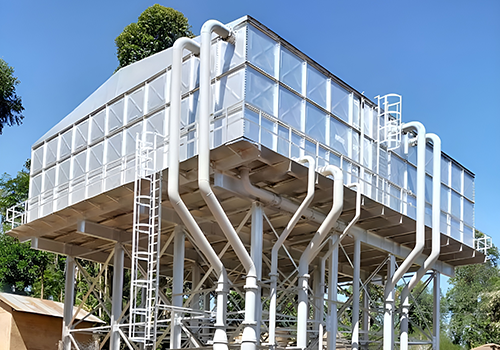
Zen Tanks, manufactured by Zenith Steel Fabricators Ltd., are designed using CNC-pressed, cut, and punched steel panels, ensuring dimensional accuracy and structural integrity. These pressed panel steel water tanks are engineered for:
- Industrial facilities
- Commercial buildings
- Residential developments
- Institutions such as hospitals and schools
- Agricultural and processing plants
Unlike generic water tanks, Zenith Steel’s Zen water tanks are designed as structural assets, integrated with elevated steel towers, rooftops, and ground-mounted structures. They are designed from an engineering-first position, aligning with the best practices of infrastructure planning, where longevity and reliability are necessary.
Due to this versatility, Zenith Steel water storage solutions can be utilized in both centralized infrastructure developments and decentralized projects.
A critical differentiator in strategic water storage is lifecycle cost, not initial capital cost. Pressed panel steel tanks are protected through hot-dip galvanizing and coating that ensure durability, low maintenance costs, and consistent water quality for municipalities and industrial and commercial users.
In environments where pH tolerance, lightweight, and chemical resistance impact water security, GRP water tanks also provide a strategic alternative. When combined with Zenith Steel’s elevated steel towers, GRP water tanks deliver hybrid solutions that optimize both strength and adaptability.
Water Storage and Structural Steel: A Strategic Convergence
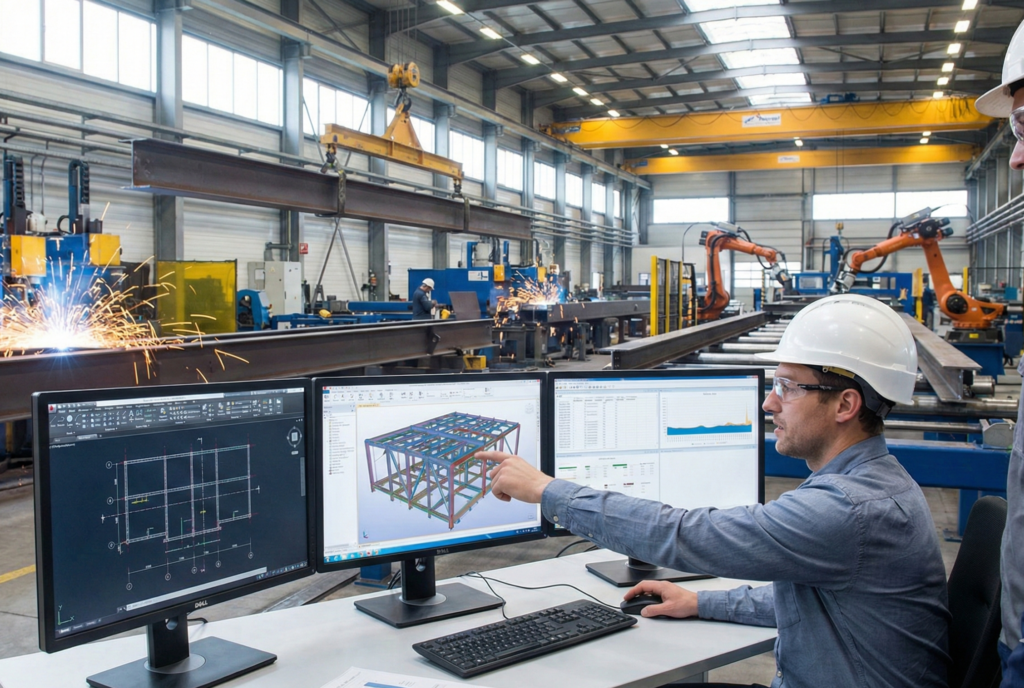
The elevation of water storage as a strategic asset has strengthened the link between structural steel fabrication and infrastructure resilience. Steel enables:
- Larger storage volumes
- Elevated installations for efficient distribution
- Modular scalability
- Faster installation timelines
Zenith Steel’s integrated capabilities in structural steelworks, CNC fabrication, and erection allow clients to source water storage systems as part of a broader infrastructure solution, rather than a standalone component.
The Strategic Implications for Infrastructure Planners
From a policy and planning perspective, water storage increasingly influences:
- Land-use planning
- Industrial zoning
- Building codes
- Environmental, Social & Governance (ESG) and sustainability measures
Developers and governments are embedding water storage capacity benchmarks into project approvals. In this environment, companies with proven expertise, such as Zenith Steel Fabricators Ltd., become strategic enablers rather than simple suppliers. The company’s investments in CNC technology, digital modeling, and precision fabrication mirror the broader shift toward data-driven, risk-aware infrastructure development.
As infrastructure planning becomes more strategic, water storage solutions will increasingly be treated as capital infrastructure. Steel water tanks of high quality offer durable water storage capacity in the next phase of development.
Conclusion
Urbanization, industrialization, and increasing climate change impacts make water security a key factor in the development of resilient infrastructures. The question isn’t whether water storage matters, but how well it is designed and whether it is durable. Strategic water storage in infrastructure planning is becoming the pillar of economic resilience.
With engineered solutions like pressed panel steel water tanks, GRP water tanks, and steel tower systems, Zenith Steel Fabricators Ltd. is helping developers, industries, and institutions transform water storage from a basic utility into a strategic advantage.
Water storage isn’t just about holding water; it’s about control, continuity, and confidence.
Build resilience into your infrastructure, starting with water!