

Water Tanks and Steel Sheds for South Sudan’s Infrastructure Development Programmes

Building Essential Infrastructure in South Sudan with Pressed Steel Water Tanks and Prefabricated Steel Sheds

South Sudan’s infrastructure deficit remains one of the most significant development challenges in East and Central Africa. Across urban centres, rural communities, humanitarian settlements, and emerging industrial zones, the need for dependable water storage systems, covered operational spaces, and fast-deployable utility buildings continues to grow. Government agencies, humanitarian organizations, multilateral partners, and private investors are under increasing pressure to deliver infrastructure that can function reliably despite limited road connectivity, harsh weather conditions, and constrained access to conventional construction materials.

In this environment, pressed steel water tanks and prefabricated steel sheds provide a highly practical infrastructure model. Manufactured off-site to controlled quality standards and assembled rapidly at project locations, these systems reduce construction risk while accelerating deployment timelines. Their modular design makes them especially suited to South Sudan’s dispersed geographies, where remote access, seasonal logistics challenges, and urgent service-delivery requirements often make brick-and-mortar construction inefficient.

From community water supply projects and health facilities to humanitarian camps, agricultural hubs, and government service compounds, steel-based infrastructure enables stakeholders to deliver permanent-grade assets faster, with greater scalability and lower lifecycle disruption.

The Infrastructure challenge in South Sudan

South Sudan’s infrastructure requirements span multiple sectors, each with immediate operational implications:

  • Water security: communities, institutions, and camps require reliable large-volume storage
  • Shelter and operational facilities: NGOs, county governments, and contractors need fast-build offices, storage, and workshops
  • Agricultural expansion: post-harvest storage and processing capacity remains limited
  • Health and education support: clinics, schools, and training centres need durable utility buildings
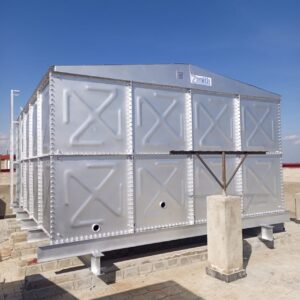
 
Structural steel erection at Zenith Steel construction site Kenya


The challenge lies not only in demand, but in how infrastructure is delivered. Remote project sites, limited skilled labor pools, seasonal road inaccessibility, and material shortages can extend conventional construction timelines significantly.

This is where modular steel solutions create measurable value.

Pressed Steel Water Tanks for South Sudan

Why Pressed Steel Panel Tanks Are Strategically Better

Pressed steel panel tanks are designed for large-capacity, remote-location deployment. Their flat-pack format allows transport on standard trucks, enabling delivery even where bulky pre-formed tanks would be impractical.

Key advantages include:

  • Scalable capacities from community systems to institutional mega-storage
  • Easy transport to remote counties and camp environments
  • Hygienic potable-water storage with food-grade liners
  • Superior UV and tropical heat resistance
  • Long service life with scheduled maintenance
  • Modular expansion as communities or facilities grow
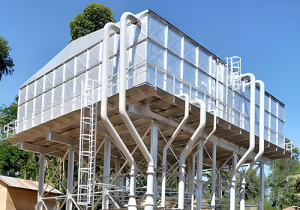
Elevated metal water storage tank


High-Impact Use Cases

  • Community and municipal water systems
  • Refugee and displacement camp water storage
  • Hospitals and rural clinic compounds
  • School and boarding institution water supply
  • Government barracks and administrative facilities
  • Industrial and private sector compounds

Prefabricated Steel Sheds for Multi-Sector Infrastructure

Fast-Deployable Operational Buildings

Prefabricated steel sheds solve one of South Sudan’s biggest infrastructure gaps: the rapid delivery of usable covered spaceBecause the structures are engineered off-site and assembled within weeks, they support faster project activation for:

  • Humanitarian warehousing
  • NGO field offices
  • Market shelters
  • Agricultural storage
  • Maintenance workshops
  • County administrative offices
  • Contractor site operations
 

For development programs operating against donor timelines, this speed advantage is critical.

Key Delivery Considerations for South Sudan Projects

A high-performing project in South Sudan depends as much on execution strategy as on material quality.

      1) Logistics and Access Planning

Road networks vary significantly by season. Dry-season route mapping and contingency delivery plans are essential.

      2) Foundation Engineering

Soil conditions differ across regions, requiring location-specific structural base design.

      3) Security and Asset Protection

Institutional and humanitarian projects should integrate perimeter and access control measures early.

      4) Skilled Installation Teams

Using experienced steel erection crews reduces assembly errors and shortens deployment cycles.

      5) Lifecycle Maintenance

Preventive inspection schedules preserve tank integrity, coatings, and shed performance over time.

Cost Drivers: What Shapes Budget Requirements

Project costs are influenced by five primary variables:

  • Tank capacity or building footprint
  • Steel specification and corrosion protection
  • Delivery distance from main logistics corridors
  • Civil works and foundation requirements
  • Installation complexity and site accessibility
 

For South Sudan, logistics often becomes the most decisive cost variable, making flat-pack steel systems significantly more cost-efficient than conventional alternatives.

Pressed Steel vs Conventional Alternatives

For large-scale infrastructure applications, pressed steel systems outperform many traditional options:

Factor

Pressed Steel Tanks

Concrete Tanks

Plastic Tanks

Capacity scalability

Scalable to very large volumes

Very large but fixed once built

Limited to smaller capacities

Remote delivery

Flat-packed – reaches locations with limited road access

Requires in-situ construction – material-intensive

Pre-formed units are bulky and difficult to transport at large sizes

Installation speed

Fast on-site assembly

Slow – weeks or months

Fast for small units

Potable hygiene

Excellent– food-grade internal liner

Yes – if properly lined

Depends on material grade

Heat & UV resistance

Excellent – coated steel

Excellent

Degrades over time under tropical UV

Lifecycle durability

Very high with proper maintenance

High

Moderate – becomes brittle over time

This makes steel especially suitable for humanitarian, institutional, and infrastructure-scale deployments.

Why Zenith Steel Fabricators for South Sudan Infrastructure

With nearly five decades of steel engineering experience and a regional footprint across 14+ African markets, Zenith Steel is strategically positioned to support complex infrastructure projects in South Sudan.

Its Zen Tanks steel water tanks and prefabricated steel sheds are designed for exactly the kind of operating realities South Sudan presents:

  • Remote deployment
  • Urgent timelines
  • Large-scale institutional needs
  • Long-term durability requirements
 

For NGOs, government bodies, contractors, and private investors, Zenith combines manufacturing quality, regional logistics capability, and sector-specific expertise to accelerate infrastructure delivery where it matters most.

Contact Zenith Steel to discuss your water tank or shed project in South Sudan.

Frequently Asked Questions

       i) Can Zenith deliver to South Sudan?

Yes. Zenith Steel has experience erecting structures across East and Central Africa, including South Sudan. Flat-pack delivery allows tanks and shed components to reach remote sites.

       ii) How quickly can tanks and sheds be assembled?

Assembly timelines are confirmed by our engineering team based on project scope and site conditions.

      iii) Are tanks suitable for potable water?

Yes, with food-grade internal liners.

      iv) Does Zenith Steel supply and install the tanks, or supply only?

Zenith Steel provides a complete supply, delivery, and installation service for Zen Tanks. The company’s experienced assembly teams erect the tanks on-site, including foundation preparation guidance, panel installation, and internal liner fitting.

       v) What foundation is needed for a large pressed steel tank?

Most large Zen Tanks installations use a concrete ring wall foundation or a compacted concrete pad, depending on tank size and local soil conditions. The foundation specification is provided by Zenith’s engineering team as part of the project planning process.m

Leave a Reply

Your email address will not be published. Required fields are marked *