

Why Does Panel Thickness Matter in Large-Capacity Steel Water Tanks?
When water storage becomes a structural challenge
As populations increase, industrial demands rises, and water security becomes a strategic priority. But with increased volumes comes increased pressure. The demand for reliable, large-scale water storage systems is high. Large-capacity steel water tanks are not just water containers, they are load bearing engineered structures.
One factor continues to determine whether a steel water tank performs safely for a long time or fails prematurely: panel thickness. Many water storage failures don’t happen because of poor installation or lack of maintenance. They happen because the tank panels were not engineered with the right thickness for the volume of water they were expected to hold. When panel thickness in steel water tanks is overlooked, the result can be leaks, deformation, premature corrosion, or structural failure.
In this article, we explore why panel thickness matter, how it affects large-capacity steel water tanks, and how Zenith Steel’s advanced fabrication delivers water tanks built for Africa’s toughest conditions.
Large capacity steel water tanks
Large capacity steel water tanks are modular water storage systems designed to hold significant volumes of water. These tanks often store hundreds of thousands to millions of litres of water. They are typically used in:
- Industrial plants
- Municipal water systems
- High-rise developments
- Agriculture and processing facilities
Unlike domestic tanks, these water storage systems must withstand:
- High hydrostatic pressure
- Long term exposure to environmental conditions
- Structural stress from elevated or ground-mounted installations
Zenith Steel fabricates steel water tanks designed for durability, scalability, and structural integrity. But at the core of their performance, is one critical factor: panel thickness.
What is panel thickness in steel water tanks?
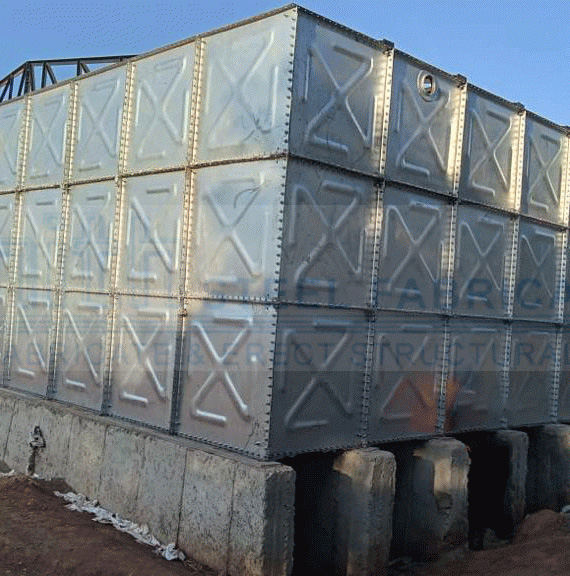
Panel thickness refers to the gauge of steel plates used to fabricate the walls, base, and roof of a tank. At Zenith Steel, steel water tanks are made using CNC-pressed, cut, and punched mild steel plates. These panels are assembled in a modular format to form rectangular tanks, depending on design requirements.
Why panel thickness varies
Zenith Steel engineers tanks with panel thickness ranging from:
- 4mm to 6mm for wall panels
- 1.5mm for roof covers
The selected thickness depends on:
- Tank depth
- Total water volume
- Installation method (rooftop, ground, steel tower)
- Environmental exposure
Panel thickness must be paired with precision fabrication. This ensures:
- Uniform panel dimensions
- Accurate bolt alignment
- Consistent load transfer across joints
Precision manufacturing prevents stress concentration, a leading cause of structural failure in poorly fabricated tanks.
Why panel thickness matters: The engineering perspective
Not all steel water tanks are engineered equally. Many market alternatives use uniform panel thickness across the entire tank, a cost-saving shortcut that can compromise performance. Instead of a one-size-fits-all approach, Zenith Steel Fabricators focuses on performance-based engineering outcomes.
The pressure exerted by water increases with the depth. In large water tanks:
- Lower panels experience more stress than upper panels
- Wall panels must resist outward bulging
- Uneven thickness leads to fatigue and deformation
Insufficient panel thickness can result in:
- Permanent deformation
- Cracking at joints
- Premature structural failure
Zenith Steel engineers calculate panel thickness using load distribution models so that every panel can carry the pressure exerted at its point in the tank without any problem. The result:
- Greater structural stability
- Longer service life
- Reduced risk of bulging, cracking, or leakage
In large-capacity steel water tanks, if the structural design is poor, failure risk increases exponentially with volume.
2. Safety and risk mitigation:
Leakage in a large-capacity water tank can result in:
- Structural damage to surrounding infrastructure
- Loss of water supply
- Significant financial and operational risk
By specifying thicker steel panels where stress is highest, Zenith Steel mitigates risks associated with:
- Sudden panel rupture
- Joint separation
- Progressive structural collapse
This approach aligns with risk-based engineering design standards across the globe.
3. Durability and corrosion resistance:
The panel thickness determines a tank’s capability to resist:
- Corrosion
- Environmental exposure
- Mechanical wear over time
Zenith Steel enhances durability by combining appropriate panel thickness with corrosion protection systems, including hot-dip galvanizing and internal and external coating. This ensures that panel thickness is preserved throughout the tank’s service life, not reduced by corrosion. Thinner panels may appear cost-effective upfront but often result in:
- Higher maintenance expenses
- Shortened service life
- Early replacement
4. Installation method:
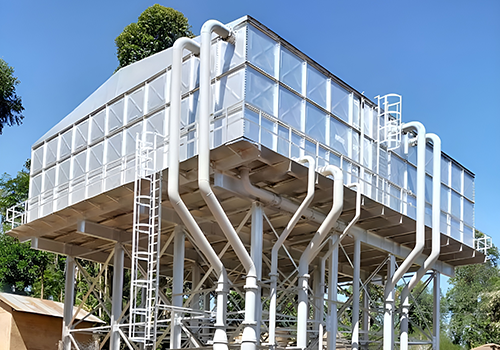
- Steel towers: Steel water tanks mounted on elevated steel towers experience dynamic loads such as wind forces, vibration, and load transfer through support columns. Zenith Steel designs steel towers using thicker lower panels supported by platforms fabricated from I-beams, 2.1 mm chequered plates, 900 mm safety railings, cat ladders, and bracing systems.
- Ground-mounted tanks: Ground–supported tanks rely on uniform load distribution and base panel strength. Panel thickness ensures the tank can withstand both vertical load and ground settlement effects.
- Rooftop tanks: rooftop installations demand reduced structural stress on buildings and optimized weight-to-strength ratios. Zenith Steel balances panel thickness and structural efficiency to ensure safety without overloading the host structure.
5. Regulatory and engineering standards:
Zenith Steel designs its steel water tanks in alignment with:
- Structural steel engineering principles
- Material strength standards
- Load and safety factors required for large-capacity storage
Panel thickness decisions are not made based on assumptions; they are validated through engineering models and real-world performance data.
Conclusion
In large-capacity steel water tanks, the thickness of the panels is not a matter of extra material; it’s about engineering expertise. And as water security demands are rising, selecting an engineered tank structure today guarantees water security for tomorrow. At Zenith Steel Fabricators Ltd., every panel thickness performance reflects decades of experience, advanced automation, and a dedication to building resilient infrastructure.
Panel thickness may not be seen after a steel water tank has been installed, but its impact is felt every day the tank performs safely and efficiently.
Are you looking for a large-capacity water storage system?
Contact Zenith Steel today to discuss your project requirements and get the right tank, built with the appropriate panel thickness from the start.