

Case Study: Zenith Steel’s 590m³ Steel Tank Project on Dwarf Walls, Uganda
Quick answer: Zenith Steel’s 590m3 (590,000 litre) water tank project in Uganda used pressed steel panels mounted on dwarf walls — a foundation method that suits sloping or unstable ground. Panels meet BS 1564 standards, the project completed on-time with full quality assurance documentation, and the tank serves a commercial water-supply role. The case study shows how dwarf-wall foundations cut civil works cost on difficult terrain.
Project Overview: A Community Water Shortage Solution
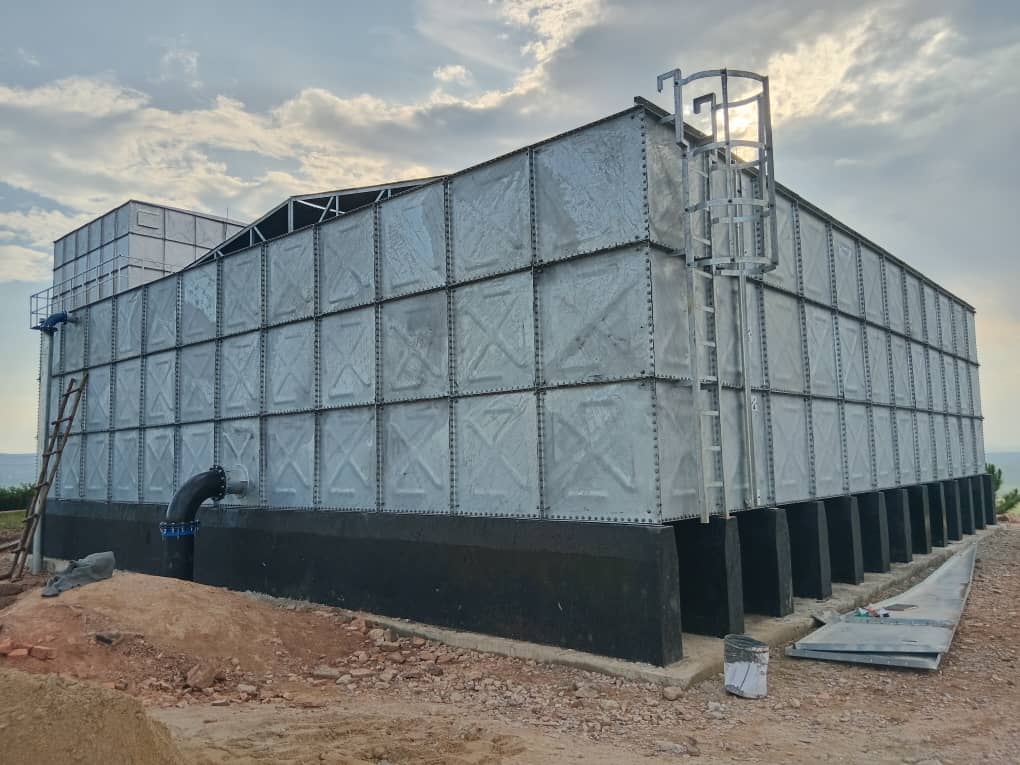
In early 2026, Zenith Steel Fabricators Ltd successfully completed the installation of a 590m³ steel water tank on dwarf walls in Uganda, delivering a long-lasting solution to a community facing persistent water shortages.
The project, finalized just a month ago, was designed to address a critical challenge: insufficient water supply for a growing community. Due to limited storage capacity and irregular access to clean water, residents had to rely on a borehole system that could not meet the demand.
Zenith Steel Fabricators Ltd stepped in to provide a large-capacity steel tank system that was designed to withstand the local environmental conditions while ensuring long-term water supply.
The Challenge: Inadequate Water Supply in a Growing Community
With over 90% of households in Uganda consuming contaminated water, clean and adequate water supply is therefore a key factor not only in public health but also in economic activities and community development.
Before the installation of the 590m³ pressed steel tank, the community faced insufficient water supply. Borehole pumping alone was not capable to meet the water demand of the community.
This was also due to:
- Limited water storage infrastructure
- Increasing demand due to population growth
- Overreliance on a borehole water source
- Salinity concerns affecting the quality of the water and the durability of the tank
Borehole was the main water source, but the problem with borehole water in many parts of Uganda is high salinity level which can accelerate tank corrosion if not protected.
As the community did not have an adequate water storage capacity, they faced periodic water shortages, especially during high demand periods. There was need for a durable and scalable steel tank system.
Why a 590m³ Steel Tank on Dwarf Walls?
Zenith Steel recommended a 590m³ bolted steel tank installed on dwarf walls for several strategic reasons:
1. High Storage Capacity
A 590m³ tank can store approximately 590,000 liters of water, significantly increasing reserve capacity. This ensures:
- Consistent supply during peak demand
- Reduced strain on the borehole pumping system
- Improved distribution efficiency
This level of engineering precision distinguishes steel water tanks East Africa built by Zenith Steel from generic alternatives.
2. Elevated Installation via Dwarf Walls
Installing the tank on dwarf walls provided:
- Enhanced structural stability
- Protection from ground-level contaminants
- Improved gravity-fed distribution potential to ensure even distribution of hydrostatic pressure
The design also lowers long-term maintenance risks compared ground-level installations in areas prone to surface water runoff.
3. Durability in Salinity Conditions
The salinity of the water was one of the major environmental factors of this project. Borehole water typically contains various salts and minerals that:
- Increase corrosion rates in unprotected steel tanks
- Compromise structural integrity over time
- Increase maintenance costs
Zenith Steel’s Approach
To address this, Zenith Steel incorporated:
- High-quality galvanization to prevent rust and ensure longevity
- Precision sealing to prevent leakages
- Structural reinforcement suited for mineral-rich water
By taking the salinity issue into account in the initial design, the tank is expected to maintain long-term structural performance, even when exposed to high-mineral water.
On-Site Technical Support: Securing Proper Installation
Another key challenge emerged during the installation phase. The local contractor was not fully conversant with installing a large-capacity steel tanks and tower systems. Improper installation could have resulted in:
- Misalignment of panels
- Compromised structural integrity
- Future leakage or safety risks
Zenith Steel’s Proactive Intervention
To safeguard project quality, Zenith Steel deployed a technical supervisor to Uganda to assist with:
- Correct assembly of the steel tank panels
- Proper sealing and fastening procedures
- Supervision of tower erection
- Ensuring compliance with engineering standards
This hands-on support ensured that the tank and tower were installed correctly, safely, and efficiently.
By providing technical oversight, Zenith Steel demonstrated its commitment not just to supplying materials, but to delivering complete, end-to-end water storage solutions.
Project Execution Process
The project followed a structured implementation plan:
1. Site Assessment
A detailed evaluation of:
- Soil conditions
- Foundation requirements
- Borehole capacity
- Community demand
2. Engineering & Fabrication
The 590m³ tank components were fabricated to specification, ensuring:
- Structural precision
- Corrosion resistance
- Ease of transport and assembly
3. Foundation & Dwarf Wall Construction
Dwarf walls were constructed to provide a stable base, ensuring load distribution and structural integrity.
4. Testing & Commissioning
The system underwent:
- Structural inspections
- Leak testing
- Operational checks
Upon successful commissioning, the tank became fully operational.

Community Impact: Beyond Water Storage
The impact of the 590m³ steel tank project on the community goes beyond the storage capacity.
1. Reliable Water Supply
The most immediate outcome is consistent and ample water availability for the concerned community. Residents now have improved access to water for:
- Domestic use
- Small-scale farming
- Sanitation and hygiene
This improves public health and living standards.
2. Economic Opportunity
A major outcome from the project is the possibility of selling surplus water beyond the immediate community. With increased storage capacity, the system can:
- Supply neighboring communities
- Support small water distribution businesses
- Generate revenue for operators
Water infrastructure thus becomes a sustainable economic asset, not just a utility.
3. Reduced Downtime & Shortages
Previously, the limited storage meant water shortage during peak demands. The 590m³ storage capacity acts as a cushion in water supply, ensuring continuous supply.
Lessons Learned
With the implementation of this project, a number of crucial insights have been reinforced in water infrastructure development in East Africa:
- The design has to match environmental conditions – Borehole salinity cannot be overlooked when selecting tank materials and coatings.
- Technical supervision guarantees longevity – Sometimes even a seasoned contractor for large-capacity steel tanks may require specialized guidance on installation.
- Water infrastructure can drive economic growth – When storage capacity exceeds basic needs, communities can monetize surplus supply.
Conclusion
The successful completion of Zenith Steel’s 590m³ Steel Tank Project on dwarf walls in Uganda stands as a major achievement in the community water infrastructure development.
What was initially a solution to water shortage has turned into a sustainable water system that not only serves the local community but also the neighbouring ones. By addressing environmental challenges like water salinity and giving installation assistance, Zenith Steel Fabricators Ltd delivered more than a tank; they delivered a long-term water security solution.
As the need for reliable water storage continues to rise in East Africa, such projects are an excellent example of how fabricated steel structures can change a community and have long-lasting benefits.
If you are planning a large-capacity water storage project in Uganda or across East Africa, partner with Zenith Steel Fabricators Ltd for expertly engineered steel tanks designed for durability, performance, and long-term value.
Contact our team today to discuss your project requirements and discover how we can help you build sustainable water infrastructure solutions.
Related Articles
Frequently Asked Questions
What are dwarf walls in water tank construction?
Short structural walls, typically 0.5 to 1.5 metres high, built as a foundation platform for elevated water tanks, providing stability and gravity-fed distribution.
What capacity of steel water tanks does Zenith Steel fabricate?
From small domestic tanks to large industrial tanks exceeding 500 cubic metres.
Why choose steel tanks over concrete for large-capacity storage?
Steel tanks offer faster installation, lower transportation costs, superior corrosion resistance, and easier maintenance.