

Industrial Water Storage in Botswana: A Strategic Infrastructure Asset

Industrial water storage Botswana plant managers and project engineers commission is not a margin call. It is the operating baseline that lets diamond pits, beef abattoirs, energy projects and Gaborone industrial estates run through a nine-month dry season. Botswana’s normal rainfall sits around 450 mm per year, dropping below 300 mm in the south-western Kalahari and reaching 650 mm only in the extreme north-east Chobe District, and even those wetter pockets concentrate rain into a short November to March window. Zen Tanks by Zenith Steel ship as flat-pack pressed-steel panels from our Nairobi works and bolt up on site to deliver industrial water storage in Botswana from 50 cubic metres to multi-thousand cubic-metre clusters.

Why Bolted Sectional Steel Wins on Industrial Water Storage in Botswana

The Kalahari, the sandveld and the eastern hardveld stress-test storage materials. Diurnal swings on a Kalahari winter day run from sub-zero before dawn to the mid-twenties by mid-afternoon, with frost at sites like Tshane and Tsabong. Average winter morning temperatures of 6 degrees Celsius against afternoon highs near 25 degrees drive a near-twenty-degree thermal cycle every twenty-four hours for half the year. Concrete reservoirs crack at the cold joints within a decade. Polyethylene bladders embrittle under combined UV and ozone loading inside five to seven years. Lined earth dams lose a punishing share of stored volume to surface evaporation across the dry window.

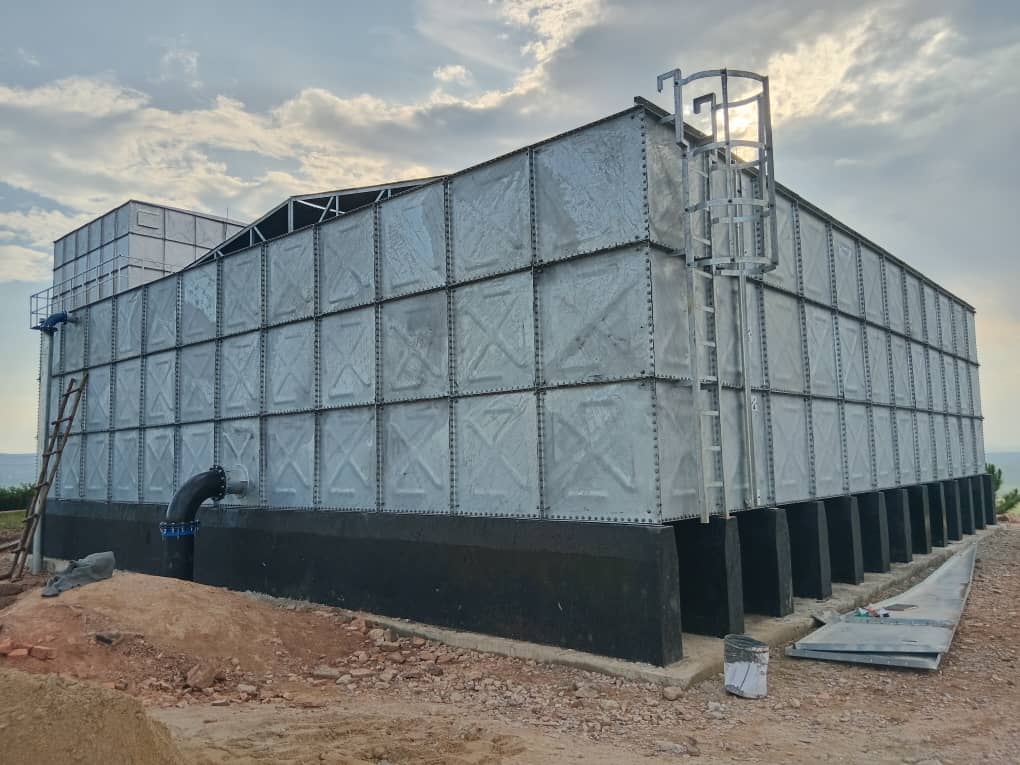
Bolted sectional steel mitigates all three failure modes. Zen Tanks panels are 4 to 6 mm pressed mild steel, hot-dip galvanised to ISO 1461 specifying minimum coating thicknesses for hot-dip galvanised articles, and designed to AWWA D103-19, the operative standard for factory-coated bolted carbon-steel tanks for water storage. A closed-lid Zen Tank loses well under one per cent of stored volume to evaporation across a month of Kalahari heat, against eight to twelve per cent for an open lined dam at the same site. For diamond-mine duty we add a zinc-rich epoxy interior topcoat over the galvanising to handle alkaline groundwater from the Kalahari-Karoo aquifer, with a 25-year design life to first major refurbishment.

Industrial water storage Botswana bolted sectional Zen Tanks panels staged at the Zenith Steel works for a Jwaneng mine project

Sectors That Drive Industrial Water Storage in Botswana

Four sectors carry most of our Botswana tank book.

Sizing and Specification on a Botswana Project

Five questions drive every industrial water storage Botswana sizing exercise that we sign off.

The first is the dry-season draw profile. A Kalahari diamond pit pulling 80 cubic metres a day for dust suppression against a 60-cubic-metre-an-hour bore yield needs at least 72 hours of buffer storage; we size the standing reserve at three to five days of operational draw. The second is the aquifer recharge constraint: where Debswana groundwater abstraction exceeds natural recharge at Orapa and Jwaneng, aboveground storage lets bore-pump duty cycle on a steady draw rather than a peak draw. The third is coating duty: alkaline groundwater plus residual concentrator chemistry attacks unprotected mild steel, so we spec a zinc-rich epoxy interior topcoat over the galvanising. The fourth is foundation design: the Lower Kalahari sand profile is bearing-capable but disperses, and the Limpopo basin’s expansive clays demand a reinforced concrete ring beam under the panel skirt. The fifth is fire-flow rating at Broadhurst, Phakalane and the SPEDU region, which folds into the tank-size calculation alongside operational draw.
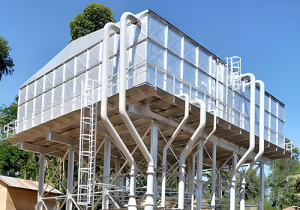
In our Botswana tank projects, the shipping math favours bolted sectional steel. Panels ship in numbered flat packs sized to standard regional truck-bed envelopes on the Mombasa-Beitbridge-Gaborone or Walvis Bay-Gobabis-Lobatse corridors, with no oversize permits needed at the border. A 500-cubic-metre Zen Tank lands as roughly 4 tonnes of pressed steel and erects in 7 to 10 days with a six-person crew, against 10 to 14 weeks for poured concrete of equivalent volume. Our Kenya Zen Tanks product family carries the same engineering into Botswana with country-specific coatings.

Industrial water storage Botswana Zen Tanks bolted sectional steel assembly on a Gaborone industrial estate project

Shipping, Erection and Commissioning

Every Zen Tanks delivery leaves Nairobi as a numbered flat-pack of pressed panels, bolt sets, gaskets, coating drums and a site erection booklet. Road handover runs via Tunduma to Kasane for Chobe and the northern lodge belt, or via Beitbridge to Gaborone for the Greater Gaborone corridor, Lobatse and SPEDU. Lead time runs 7 to 9 weeks ex-Nairobi plus 7 to 14 days in road transit. We dispatch a supervisor on projects above 500 cubic metres.

A typical commissioning file for industrial water storage in Botswana includes the mill-certificate trail, the galvanising film-thickness log, the bolted-joint torque chart, the internal coating dry-film thickness map, the hydrostatic test record at full design head, and a chlorine-flush certificate for potable duty. We also issue the foundation drawing set and an Atterberg-limits requirement before shop-floor release. The same discipline carries into our multi-storey steel building work and our structural steelworks for commercial and industrial projects. Our Namibia water storage as a strategic asset post sets the regional context that Botswana sits inside.

Working With Zenith Steel on a Botswana Project

To discuss a diamond-mine, abattoir, industrial-park or lodge requirement, project teams can reach us via the contact page or request a panel schedule and delivered-to-site cost through the project quotation form. We respond within two working days with a costed proposal and indicative shipping route.

Frequently Asked Questions

What is the design life of a Zen Tank under Kalahari operating conditions?

Twenty-five years to first major refurbishment on the standard hot-dip galvanised specification, longer where we apply a zinc-rich epoxy topcoat over the galvanising. The Kalahari thermal cycle is severe, but bolted sectional steel handles the swing better than concrete cold joints or polyethylene walls.

Can Zen Tanks be installed at off-grid mine sites with no specialist plant?

Yes. Flat-pack delivery, manual bolt-up by a six-person crew, no specialist crane required for tanks up to roughly 500 cubic metres. We supply the erection booklet and torque-wrench schedule, and dispatch a Zenith Steel supervisor on tank orders above 500 cubic metres.

Are insulated jackets available where the Kalahari winter night risks freezing?

Yes. We offer a rock-wool insulated cladding pack for potable storage where temperature stability is critical, sized to the operating temperature band agreed with the project engineer. The cladding ships in the same flat-pack as the tank.

How does Zen Tanks handle alkaline Kalahari groundwater on diamond-mine duty?

We spec a zinc-rich epoxy interior topcoat over the hot-dip galvanising, with annual film-thickness inspection at the manway and a 10-year recoat trigger on the wetted-zone band. The exterior coating spec runs to a 25-year design life under standard Kalahari UV and thermal cycling.

Leave a Reply

Your email address will not be published. Required fields are marked *