

Large-Scale Steel Water Tanks for Ethiopia’s Irrigation Schemes and Agro-Industrial Projects
Ethiopia’s Agricultural Expansion Depends on Scalable Water Infrastructure
Ethiopia is entering a defining phase in its agricultural and industrial transformation. From large-scale irrigation corridors and commercial farms to sugar processing zones and export-driven flower farms, the country’s growth agenda increasingly depends on one overlooked infrastructure asset: reliable large-capacity water storage.
For many projects, the real challenge is not only water access, but the ability to store, protect, and distribute water efficiently across remote and operationally demanding sites.
This is where steel water tanks in Ethiopia have emerged as a strategic infrastructure solution. Unlike conventional concrete reservoirs or limited-capacity plastic tanks, pressed steel panel tanks combine very large storage volumes, rapid site deployment, long lifecycle performance, and flat-pack logistics, making them especially suited for Ethiopia’s varied terrain and expanding agricultural economy.
For developers, contractors, government agencies, and agro-industrial investors, choosing the right storage system can directly affect crop reliability, production continuity, and long-term operational costs.
Ethiopia’s Water Storage Challenge: The Infrastructure Gap Behind Agricultural Growth
Agriculture remains one of Ethiopia’s most important economic pillars, yet a significant portion of arable land still depends on seasonal rainfall. As irrigation investment expands through:

- government-led irrigation schemes
- private commercial farming
- export horticulture
- sugar and ethanol projects
- food processing zones
…the need for buffer storage between source supply and field demand becomes mission-critical. Water sources such as rivers, boreholes, dams, and pumping stations rarely deliver at the same consistency as crop demand cycles.
This creates a major infrastructure question:
How do operators guarantee uninterrupted water availability?
The answer lies in high-volume steel water tanks that stabilize supply fluctuations and support continuous downstream distribution. For agro-industrial operations, this same challenge affects:
- process water continuity
- sanitation systems
- cooling operations
- cleaning cycles
- fire reserve storage
- institutional daily usage
Without robust storage, production downtime and irrigation inefficiencies become costly risks.
Why Pressed Steel Panel Tanks for Ethiopia
1) Large Capacity for Large Irrigation and Industrial Projects
One of the biggest advantages of steel tanks is scalability. Zenith Steel’s tanks are custom-fit with a capacity range of 5,000 Litres – 1,000,000 litres, making them ideal for:
- irrigation buffer reservoirs
- factory process water systems
- municipal developments
- industrial parks
- livestock and agro estates
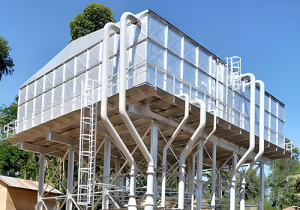
This flexibility gives project planners room to align storage with:
- daily demand
- refill frequency
- dry-season reserve targets
- operational risk tolerance
Compared to plastic tanks, steel tanks support larger capacities, while remaining more commercially practical than massive cast-in-place concrete reservoirs.
2) Flat-Pack Logistics for Remote Ethiopian Sites
A major strategic advantage for Ethiopia is transport efficiency. Steel tanks are delivered as individual steel panels, roof sheets, bolts, and fittings, allowing them to be:
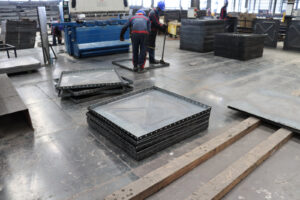
- flat-packed
- stacked efficiently
- transported on standard trucks
- moved into hard-to-reach agricultural regions
This is particularly valuable in:
- highland farming zones
- valley irrigation corridors
- remote sugar plantations
- industrial developments with limited road infrastructure
For projects outside major cities, this logistics model significantly lowers delivery complexity.
3) Faster Project Delivery Than Concrete Reservoirs
In large infrastructure projects, speed directly affects ROI. Steel panel tanks can be assembled quickly once the foundation is complete, reducing delays in:
- irrigation commissioning
- crop planting cycles
- factory startup
- institutional occupancy
Equivalent concrete storage systems may require weeks or months of formwork, curing, and waterproofing, while steel tanks offer a far faster route to operational readiness.
4) Long-Term Durability in Ethiopia’s Climate Conditions
Ethiopia’s environments range from hot lowlands to cooler highlands, making material durability essential. With:
- corrosion-resistant coatings
- galvanized steel finishes
- food-grade internal liners
- UV-resistant top covers
…steel tanks provide long service life with predictable maintenance cycles. For public-sector and agro-industrial investors, this makes them a highly bankable long-term infrastructure asset.
Applications in Ethiopia
- Irrigation Buffer Storage – Large steel tanks serve as buffer storage between water abstraction (pumps, gravity-fed intakes) and the irrigation distribution system. This ensures consistent water delivery to fields even when the primary supply fluctuates.
- Agro-Industrial Processing – Sugar mills, breweries, flower farms, and food processors require predictable water supply for their production processes. Steel water tanks in Ethiopia provide the reliable, high-volume storage these operations need.
- Institutional and Urban Supply – Universities, hospitals, industrial parks, and urban developments use large steel tanks for daily water supply. The tanks serve as the primary storage point in the facility’s water distribution system.
Planning the Right Pressed Steel Tank System
Key planning variables:
- Capacity sizing: daily demand + reserve hours
- Foundation engineering: compacted base + reinforced dwarf wall
- Liner specification: potable vs irrigation vs industrial
- Top covers: evaporation control + contamination prevention
- Hydraulic fittings: inlet, overflow, washout, level monitoring
- Transport feasibility: truck access to remote Ethiopian sites
- Expansion readiness: future demand growth planning
This systems-thinking approach helps reduce lifecycle cost overruns.
Common Mistakes That Increase Water Infrastructure Costs
Projects often underperform due to avoidable planning errors. Most common issues:
- Undersizing actual peak demand
- Inadequate foundation preparation
- Incorrect liner specification
- Ignoring site logistics constraints
- No periodic maintenance and inspection schedule
For long-term ROI, these decisions matter as much as the tank itself.
Pressed Steel Panel Tanks vs Concrete vs Plastic for Large-Capacity Water Storage
Water storage systems come in several forms. Here is how steel panel tanks compare against the main alternatives for large-capacity applications:
Factor | Pressed Steel Panel Tanks | Concrete Reservoirs | Plastic / Poly Tanks |
Capacity range | Scalable to very large volumes | Very large but fixed once built | Limited to smaller capacities |
Delivery to remote sites | Flat-packed and easy to transport to locations with limited road access | Requires in-situ construction and significant material transport | Pre-formed units are bulky and difficult to move at large sizes |
Assembly time | Fast on-site assembly | Slow — can take weeks or months | Fast for smaller units |
Hygienic for potable use | Yes — with food-grade internal liner | Yes — when properly lined | Depends on material grade |
UV and heat resistance | Excellent with coated steel panels | Excellent | Moderate — may degrade over time under tropical UV |
Long-term durability | Very high with proper maintenance | Very high | Moderate — can become brittle over time |
Pro Tips
- Conduct a detailed water demand study before sizing the tank
- Plan the foundation well in advance – it determines the tank’s long-term performance
- Specify a roof cover to minimise evaporation and maintain water quality
- Work with a fabricator experienced in delivering to remote East African locations
- Schedule maintenance inspections every two to three years
Why Zenith Steel for Water Tanks in Ethiopia
Zenith Steel Fabricators manufactures the Zen Tanks range of steel water tanks with delivery across 14 African countries including Ethiopia. Zen Tanks are available in very large capacities and are designed for flat-pack delivery and on-site assembly.
With nearly five decades of experience and the logistical capability to deliver across East Africa, Zenith provides the reliability and capacity that large-scale water projects in Ethiopia demand.
Contact Zenith Steel to discuss your water storage requirements in Ethiopia.
Frequently Asked Questions
i) Can Zenith deliver water tanks to rural Ethiopia?
Yes. Zen Tanks are flat-packed for delivery on standard trucks, allowing them to reach remote locations. Transport logistics are managed as part of the project.
ii) What is the largest tank available?
Zen Tanks pressed panel tanks can be configured for very large volumes. The modular design allows tanks to be configured to virtually any required capacity.
iii) How long does assembly take for a large tank?
A large-capacity tank can be assembled on-site efficiently, with timelines depending on size and site conditions.
iv) Are steel tanks suitable for potable water?
Yes, with food-grade internal liners. The liner prevents contact between the water and the steel panels, maintaining water quality.
v) Does Zenith Steel supply and install the tanks, or supply only?
Zenith Steel provides a complete supply, delivery, and installation service for Zen Tanks. The company’s experienced assembly teams erect the tanks on-site, including foundation preparation guidance, panel installation, and internal liner fitting.
vi) What foundation is needed for a large pressed steel tank?
Most large Zen Tanks installations use a concrete ring wall foundation or a compacted concrete pad, depending on tank size and local soil conditions. The foundation specification is provided by Zenith’s engineering team as part of the project planning process.
