

Solving Water Storage for Off-Grid Communities and Farms in Rural Uganda
Why Water Storage Infrastructure Is Becoming a Strategic Priority in Rural Uganda
Water scarcity remains one of the most pressing infrastructure challenges across rural Uganda. While the country benefits from significant annual rainfall, seasonal variability, reliance on borehole water, and growing agricultural demand continue to widen the gap between water availability and water access. For farms, schools, health centres, dairy operations, NGOs, and community water schemes, the challenge is rarely water presence alone, it is how effectively that water can be stored, protected, and distributed during dry periods.
This is where large-capacity steel water tanks from Zenith Steel provide a practical, scalable solution.
Unlike conventional plastic tanks that are often limited in volume and difficult to scale, Zenith Steel’s water tanks are engineered for high-capacity storage, flat-pack transportation, and fast on-site assembly, making them particularly suited for remote and off-grid projects across Uganda.
For decision makers planning irrigation systems, rural water projects, institutional supply networks, or livestock farms, the strategic question is no longer whether storage is needed, but rather:
What tank system delivers the lowest lifecycle cost, fastest deployment, and strongest durability in rural East African conditions?
The Rural Uganda Water Storage Gap: A High-Impact Infrastructure challenge
Across Uganda, most rural communities depend on one or a mix of:
- Boreholes
- Gravity-fed schemes
- Seasonal rainwater harvesting
- Rivers
- Intermittent piped supply
The challenge is that water demand remains constant while supply is seasonal and infrastructure-dependent. This creates three major operational risks:
- Dry-season supply interruptions – During prolonged dry months, communities and farms without sufficient storage face acute shortages.
- Agricultural productivity losses – For irrigation-dependent farms, inconsistent water access directly reduces yields, crop quality, and planting flexibility.
- Institutional Service Disruptions – Schools, hospitals, and health centres require uninterrupted water for sanitation, cooking, cleaning, and daily operations.
Zenith steel tank transforms irregular supply into predictable availability, helping users bridge the gap between wet-season abundance and dry-season demand.
Why Steel Tanks for Rural Water Storage
1) Scalable Capacity for Community and Agricultural Use
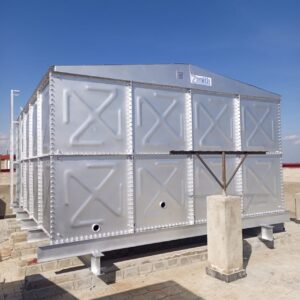
Large-scale rural projects demand water storage systems that can grow with demand. Zenith Steel’s pressed panel tanks can be configured into small, medium, or very large-capacity reservoirs (5,000 Litres – 1,000,000 Litres), making them suitable for:
- Community water schemes
- Irrigation reservoirs
- School and hospital storage
- Dairy and livestock farms
- Commercial agribusiness operations
This scalability is a major advantage over plastic alternatives, which are typically limited to smaller standard moulded sizes.
2) Flat-Pack Logistics for Rural Sites
One of the most strategic advantages of Zenith Steel water tanks is their flat-pack panel design. Panels are fabricated individually, allowing them to be:
- Transported on standard trucks
- Delivered to remote rural roads
- Moved to constrained project sites
- Assembled on-site with minimal heavy machinery
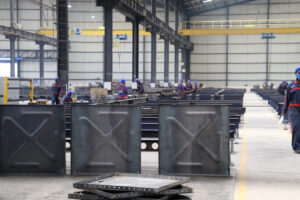
For NGOs, county water departments, and rural developers working in hard-to-access districts, this significantly reduces logistics complexity and transport costs.
3) Long-Term Durability in Tropical Conditions
Uganda’s climate exposes storage systems to:
- High UV radiation
- Seasonal heavy rainfall
- Temperature fluctuations
- Dust and physical impact
- Agricultural operating wear

Zenith Steel tanks are engineered using high-strength coated steel panels that offer:
- Superior UV resistance
- Structural stability
- High impact resistance
- Long service life
- Low maintenance requirements
With proper inspections, these systems can remain operational for decades.
4) Hygienic and Safe Potable Water Storage
For schools, hospitals, and rural households, water quality is as critical as water quantity. Zenith Steel tanks use food-grade internal liners that make them suitable for:
- Drinking water
- School sanitation systems
- Clinical use
- Kitchen and food-prep supply
- Dairy farm wash-down systems
The enclosed system reduces contamination from:
- Animals
- Insects
- Dust
- Surface debris
- Algae growth
This is especially important for NGO-led and rural public health projects.
Applications for Steel Water Tanks in Uganda
- Agricultural irrigation – Commercial and smallholder farmers need reliable water storage for irrigation during dry periods. Steel tanks connected to borehole or river abstraction systems provide buffer storage that allows irrigation to continue regardless of daily water availability.
- Community water schemes – NGOs and government agencies building community water systems use steel tanks as elevated or ground-level storage reservoirs. The tanks serve as the central storage point for gravity-fed distribution networks serving households, schools, and health centres.
- Institutional use – Schools, hospitals, and military installations require large-volume water storage that is reliable, secure, and low-maintenance. Steel tanks meet these requirements and can be sized to match the specific daily demand of the institution.
- Livestock and dairy farming – Dairy cattle and other livestock require consistent access to clean water. Steel tanks placed at strategic points on the farm ensure water availability for animal drinking, cleaning, and cooling – directly supporting animal welfare and productivity.
Key Considerations When Specifying Steel Water Tanks for Uganda
Before selecting a tank size or configuration, project teams should assess:
- Required capacity – based on daily demand, refill frequency, and buffer for dry periods
- Site access – can delivery trucks reach the location? Pressed panel tanks are ideal for areas with limited access
- Foundation requirements – a level, compacted base (typically a concrete wall or compacted gravel pad) is needed
- Water source – borehole, rainwater, piped supply, or a combination
- Liner specification – food-grade liners are essential for potable water storage
- Elevation – elevated tanks provide gravity-fed pressure for distribution systems
What Determines Steel Water Tank Project Pricing in Uganda?
- Tank capacity (litres or cubic metres)
- Panel material and coating specification
- Food-grade liner requirements
- Foundation type and site preparation
- Transport distance from the fabrication facility to the project site
- Assembly and installation labour
For projects in Uganda, transport costs from the manufacturing facility should be factored into the overall budget. Working with a fabricator who has experience delivering to remote East African locations reduces the risk of logistical delays and damage.
Common Mistakes in Water Tank Projects
- Underestimating required capacity – always calculate based on peak demand, not average
- Choosing plastic tanks for large-capacity needs where steel would be more durable and cost-effective
- Not preparing a proper foundation before tank assembly
- Failing to specify food-grade liners for potable water storage
- Not planning for long-term maintenance, including periodic inspection and liner replacement
Pro Tips for Water Storage Projects in Uganda
- Conduct a water demand assessment before sizing the tank – account for population growth, seasonal variation, and future expansion
- Use pressed panel tanks for sites with difficult road access – flat-pack delivery is a major advantage
- Plan for rainwater harvesting integration – connecting roof catchment to a steel tank is a low-cost way to supplement supply
- Invest in a quality foundation – this is the single most important factor in the long-term performance of the tank
- Schedule periodic inspections every two to three years to check liner condition, panel joints, and fittings
Steel Tanks vs Concrete vs Plastic Tanks
Water storage systems come in several forms. Here is how pressed steel panel tanks compare against the main alternatives for large-capacity applications:
Factor | Steel Tanks | Concrete Tanks | Plastic / Poly Tanks |
Capacity range | Scalable to very large volumes | Very large but fixed once built | Limited to smaller capacities |
Delivery to remote sites | Flat-packed; ideal for limited road access | Requires in-situ construction and bulk materials | Pre-formed units become bulky and hard to transport at scale |
Assembly time | Fast on-site assembly | Slow; can take weeks or months | Fast for small-capacity units |
Hygienic for potable use | Yes; food-grade internal liner | Yes, if properly lined | Depends on material grade |
UV and heat resistance | Excellent; coated steel resists tropical exposure | Excellent | Moderate; degrades over time under UV |
Long-term durability | Very high with proper maintenance | Very high | Moderate; may become brittle with age |
Scalability for future expansion | Excellent; panels can be expanded in phases | Low; difficult to modify once cast | Low; expansion usually requires new units |
Lifecycle cost efficiency | High long-term ROI | High upfront civil cost | Lower upfront cost, higher replacement frequency |
Why Zenith Steel for Water Tanks in Uganda
Zenith Steel Fabricators manufactures the Zen Tanks range of pressed panel steel water tanks at their facility in Nairobi, with an annual production capacity of 40,000 metric tonnes across all product lines. Zen Tanks are available in a wide range of capacities and are designed for flat-pack delivery and on-site assembly.
Zenith Steel erects water storage solutions across Uganda. The Zen Tanks system is used by farms, institutions, NGOs, and government projects across East Africa.
Frequently Asked Questions
i) What is the largest water tank Zenith can supply?
Zen Tanks pressed panel water tanks can be configured in very large capacities. The modular panel system allows tanks to be sized to specific project requirements.
ii) Can steel tanks be used for potable water?
Yes. Steel tanks with food-grade internal liners are suitable for storing potable water. The liner prevents contact between the water and the steel panels, ensuring water quality is maintained.
iii) How long does it take to assemble a pressed panel tank?
Assembly time depends on tank size. A community-scale tank can be assembled efficiently on-site by an experienced crew. Larger tanks may take longer.
iv) Do steel tanks rust?
Zen Tanks panels are coated to resist corrosion, and the internal liner provides an additional barrier between the water and the steel. With proper maintenance and periodic inspection, corrosion is not a concern during the normal service life of the tank.
v) Can a steel tank be relocated?
Yes. Because pressed panel tanks are bolted together rather than welded, they can be disassembled, transported, and reassembled at a new location. This is a significant advantage for temporary projects or organisations that may need to relocate infrastructure.
vi) Does Zenith Steel supply and install the tanks, or supply only?
Zenith Steel provides a complete supply, delivery, and installation service for Zen Tanks. The company’s experienced assembly teams erect the tanks on-site, including foundation preparation guidance, panel installation, and internal liner fitting.
vii) What foundation is needed for a large pressed steel tank?
Most large Zen Tanks installations use a concrete ring wall foundation or a compacted concrete pad, depending on tank size and local soil conditions. The foundation specification is provided by Zenith’s engineering team as part of the project planning process.
