

Steel Church Buildings in South Sudan: Permanent Structures for Growing Communities of Faith

From Temporary Shelters to Permanent Worship Infrastructure

Across South Sudan, faith communities are expanding at a remarkable pace. From urban centres like Juba to rural regions, congregations are gathering in increasing numbers, often in temporary structures such as tents, timber shelters, or open-air spaces.

While these setups serve an immediate need, they present long-term limitations: exposure to weather, limited capacity, and lack of permanence. As congregations grow, so does the need for scalable, durable, and future-ready infrastructure.

Steel church buildings in South Sudan present a high-impact solution. Drawing from global best practices in structural engineering and modular building systems, companies like Zenith Steel Fabricators are enabling churches to transition from temporary shelters to permanent, multi-functional spaces, faster and more efficiently than traditional methods.

The Need for Permanent Church Buildings

A church in South Sudan is more than a place of worship, it is a social anchor. Permanent church buildings often serve as:

  • Community gathering hubs
  • Educational spaces and informal schools
  • Relief distribution centres
  • Venues for social and cultural events
 

However, traditional masonry construction poses significant challenges:

  • High costs due to material and labour constraints
  • Extended timelines, often spanning months or years
  • Limited accessibility in remote or infrastructure-poor regions
 

These constraints hinder community development. Steel construction, by contrast, offers a scalable and replicable model that aligns with both immediate and long-term needs.

Why Steel for Church Buildings

       1. Large Column-Free Spans

One of the most critical requirements for any church is an open, unobstructed interior. Steel structures enable clear spans of 20 metres or more, eliminating the need for internal columns. 
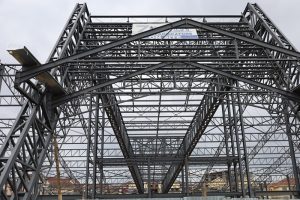
Republic of Congo Goma church - zenith-steel

This allows:

  • Better visibility for congregants
  • Flexible seating arrangements
  • Enhanced acoustics and engagement
 

For growing congregations, this flexibility is essential, spaces can adapt without structural limitations.

       2. Fast Construction
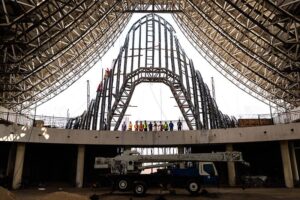
Zenith Steel fabricators Ltd - Projects - steel structures

Speed is a decisive factor, especially for communities transitioning from temporary shelters. Steel church buildings are:

  • Pre-engineered and fabricated off-site
  • Delivered as ready-to-assemble components
  • Installed in weeks rather than months
 

This significantly reduces project timelines and allows congregations to begin using their new space much sooner. For organizations managing multiple church projects, this also enables standardization and rapid replication across different locations.

        3. Durability

South Sudan’s climate presents challenges, including heat, seasonal rains, and pests. Steel structures, especially those that are galvanized offer:

  • Resistance to corrosion and rust
  • Resistance to termite damage
  • Structural integrity over decades
 

This translates to lower lifecycle costs, making steel a financially sustainable investment for churches with limited long-term maintenance budgets.

        4. Deliverability

A major barrier to construction in South Sudan is logistics. Steel construction addresses this through:

  • Transportable components that fit on standard trucks
  • Minimal reliance on locally sourced materials
  • Reduced need for specialized on-site labour
 

This makes it possible to deliver and assemble buildings even in hard-to-reach areas, ensuring equitable infrastructure development across regions.

Design Considerations for Steel Churches

To maximize value and usability, steel church buildings in South Sudan should be designed with both present and future needs in mind. This includes: 

  • Capacity Planning – Design for projected growth, not just current work. Modular steel systems allow for future expansion.
  • Acoustic performance – Large open spaces require thoughtful acoustic enhancements to ensure clarity during sermons, worship, and events.
  • Ventilation – In South Sudan’s warm climate, consider open-sided designs, louvered wall systems, and natural airflow optimization.
  • Multi-purpose use – Incorporate partitionable spaces , classrooms or meeting rooms , storage and administrative areas.
  • Foundation – Adapt foundation systems to local soil conditions, an area where experienced firms like Zenith Steel Fabricators provide critical technical guidance.

Cost Factors: What Influences Steel Church Construction Costs?

Understanding cost components is key to effective project planning. Primary factors include:

  • Building size and span
  • Roofing and cladding materials
  • Interior finishes and acoustic enhancements
  • Foundation requirements based on site conditions
  • Transport to the church site in South Sudan
 

While initial costs may vary, steel structures consistently deliver higher long-term value through durability, speed, and reduced maintenance.

Steel Frame vs Masonry Construction for Churches: At a Glance

Congregations in East Africa have traditionally built with masonry, but steel is increasingly the preferred choice for larger, permanent worship facilities. Here is why:

FactorSteel Frame ConstructionMasonry Construction (Alternative)
Clear Interior SpanLarge column-free spans with unobstructed sightlines throughout the worship spaceLimited by load-bearing walls; internal columns often required
Construction TimeFast — structural frame can be erected in weeksSlow — requires months of bricklaying and curing
Acoustic ManagementRequires acoustic treatment such as panels and insulationInherent wall mass provides some natural sound absorption
Expansion PotentialHighly flexible — additional bays can be addedDifficult and disruptive to expand once built
Design FreedomHigh flexibility — external appearance determined by cladding, allowing diverse architectural stylesLimited — structural system constrains design options
Long-Term MaintenanceLow — galvanised or coated steel requires minimal upkeepModerate — prone to cracking, rising damp, and roof truss issues over time

Why Zenith Steel for Church Buildings in South Sudan

Zenith Steel Fabricators builds church structures across 14 African countries including South Sudan. With large-span capability, nearly five decades of experience, and delivery logistics for remote East African locations, Zenith provides the quality and reliability that church building projects require.

Contact Zenith Steel to discuss your church building project in South Sudan.

Frequently Asked Questions

        i) How long does a steel church take to build?

Project timelines depend on the scope, size, and site conditions of your project. Our engineering team will provide a detailed schedule during the planning phase. Project timelines are confirmed by our engineering team based on project scope, site conditions, and location. 

Contact Zenith Steel to discuss your project.

       ii) Can a steel church be made to look like a traditional church?

Yes. Steel is the structural system – the external appearance is determined by cladding and architectural finishes.

      iii) Can Zenith deliver to remote areas in South Sudan?

Yes. Steel components are transported flat or nested on standard trucks, allowing delivery to locations with limited infrastructure.

      iv) Can a steel church be designed to look like a traditional building on the outside?

Yes. The external appearance of a steel-framed church is determined entirely by the cladding, finishes, and architectural design – not by the structural system. Steel churches can incorporate traditional architectural elements, stone-effect cladding, arched windows, and steeple features, giving the building the aesthetic the congregation desires.

       v) Does Zenith Steel handle permits and approvals for church buildings?

Zenith Steel’s project team provides guidance on the approval process and works with the congregation’s representatives and local authorities. Responsibility for securing building permits sits with the client, but Zenith provides the necessary structural documentation and drawings required for the approval submission.

Leave a Reply

Your email address will not be published. Required fields are marked *