

Steel Factories and Industrial Buildings for Zimbabwe’s Manufacturing Sector

Zimbabwe’s Manufacturing Sector Is Entering a New Growth Cycle

Zimbabwe’s manufacturing sector is steadily moving from recovery to reinvestment. Growth in food processing, mining support services, agro-processing, light manufacturing, packaging, and regional export operations is driving renewed demand for industrial infrastructure. As capital begins flowing into Harare, Bulawayo, Gweru, Mutare, and Special Economic Zones, one question becomes increasingly strategic:

How can manufacturers build factory facilities that reduce time-to-production while protecting long-term operating costs? The answer increasingly lies in steel factory buildings. For modern manufacturers, the factory is a production asset that directly influences throughput, workflow efficiency, future expansion, and cost competitiveness. This is where steel structures outperform conventional alternatives.

For businesses looking to accelerate market entry or expand existing plants, steel enables a faster and more strategic route to industrial growth.

Why Steel Factory Buildings Are the Smart Choice in Zimbabwe

  Steel factory buildings offer:

     1) Faster Construction Means Faster Revenue Realization

In manufacturing, delayed construction often means delayed production, missed contracts, and slower payback periods. Steel factory buildings are fabricated off-site and assembled rapidly on location, significantly reducing build timelines compared to traditional concrete methods.
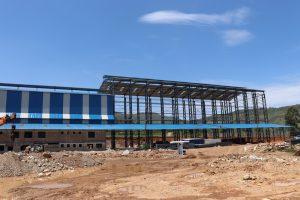
Steel frame building under construction.

For Zimbabwean manufacturers operating in competitive regional supply chains, this speed helps:

  • shorten time-to-market
  • accelerate commissioning
  • reduce site labour dependency
  • minimise disruption on active industrial sites
 

For expansion projects, this can directly improve capital efficiency and return on invested assets.

      2) Clear-Span Layouts Improve Production Flow

One of the biggest advantages of steel is the ability to create large uninterrupted floor spaces. Using portal frame systems, steel factories can achieve 20–40 metre clear spans without internal columns.
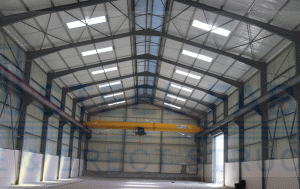
crane buildings

This creates major operational benefits:

  • uninterrupted assembly or packaging lines
  • better forklift and logistics movement
  • flexible zoning for raw materials and finished goods
  • easier machine layout optimisation
  • better safety and line-of-sight supervision
 

For sectors such as food processing, mining equipment assembly, or FMCG packaging, layout efficiency directly impacts throughput and labour productivity.

       3) Lower Cost per Square Metre for Single-Storey Industrial Use

For most single-storey factories, steel structures are typically more cost-efficient than heavy concrete systems. The value comes from:

  • lighter structural loads
  • smaller foundation requirements
  • reduced excavation
  • lower labour costs
  • shorter equipment hire durations
  • faster completion cycles
 

This makes steel especially attractive for mid-sized industrial investors and export manufacturers in Zimbabwe looking to preserve capital for machinery and working operations. This shifts more budget into production assets instead of structural overhead.

        4) Long-Term Durability for Zimbabwe’s Operating Conditions

Factory infrastructure must remain reliable for decades. Steel buildings by Zenith Steel Fabricators are engineered and galvanized to resist:

  • corrosion
  • termite damage
  • moisture exposure
  • weather-related degradation
 

This durability is especially important in Zimbabwe, where manufacturers need facilities that can withstand seasonal climate shifts, industrial wear, and long-term expansion cycles.

The result is a factory asset with lower lifecycle maintenance costs and higher structural reliability.

Strategic Design Considerations for Factory Buildings in Zimbabwe

The highest-performing industrial buildings are designed around the production process, not just the footprint. For manufacturers planning new factory facilities, six structural decisions are critical:

    i) Production Flow Alignment

The building layout should follow the movement of:

  • raw material intake
  • processing
  • assembly
  • packaging
  • dispatch
 

This reduces internal transport waste and improves operational efficiency.

    ii) Clear Height Requirements

The internal height must accommodate:

  • the tallest machinery
  • conveyors
  • ventilation ducts
  • racking systems
  • crane movement clearance
 

   iii) Crane Rail Integration

Steel frames make it easier to integrate:

  • gantry cranes
  • overhead bridge cranes
  • hoists
  • maintenance lifting systems
 

    iv) Ventilation and Extraction

For industries with heat, dust, or fumes, the roof and wall system should support:

  • ridge ventilation
  • extraction fans
  • louvre systems
  • airflow zoning
 

     v) Floor Loading

Heavy production lines may require:

  • reinforced slab zones
  • machine plinths such as CNC machines
  • vibration-resistant pads
 

    vi) Future Expansion

A strong industrial strategy always includes growth. Steel buildings can be designed for:

  • side extensions
  • length extensions
  • mezzanine additions
  • future crane upgrades
 

This makes the factory a scalable platform rather than a fixed-capacity asset.

What Influences the Cost of Steel Factory Buildings in Zimbabwe?

Several factors determine final project cost:

  • Total building size
  • Span width and height
  • Roofing and cladding specification
  • Insulation requirements
  • Slab reinforcement levels
  • Crane beam systems
  • Transport logistics into Zimbabwe
  • Customs and delivery coordination
  • On-site erection complexity
 

The most cost-effective projects are those where the structure is designed around production value drivers, not generic warehouse assumptions.

This is where experienced industrial fabricators create significant value.

Steel Factory Building vs Concrete Construction: Strategic Comparison

Manufacturing and processing facilities have specific structural requirements. Here is how steel compares to concrete for factory construction in East Africa:

Factor

Steel Factory Building

Conventional Concrete Alternative

Production floor layout

Large clear spans, no internal columns

More columns restrict workflow

Crane integration

Easily integrated into frame

More complex and costly

Construction speed

Fast erection, reduced downtime

Slower construction cycles

Expansion flexibility

Easy to extend and modify – move walls, add cranes, extend the building 

High-cost modifications

Foundation loads

Lighter, smaller foundations

Heavier groundworks

Long-term scalability

High adaptability

Low flexibility

Regulatory compliance

Faster operational start – complies with local building codes when properly engineered 

Standard approach – widely accepted

Why Zenith Steel for Factories in Zimbabwe

With nearly five decades of fabrication expertise and delivery across 14 African countries, Zenith Steel Fabricators brings the scale and technical capability required for complex industrial factory projects. With an annual production capacity of 40,000 metric tonnes, Zenith supports manufacturers building in various areas such as HarareMutare, Gweru, mining and agro-industrial corridors, and export processing zones

The result is a factory building that supports faster commissioning, stronger productivity, and long-term operational resilience.

Contact Zenith Steel to discuss your factory project in Harare, Bulawayo, or elsewhere in Zimbabwe.

Frequently Asked Questions

      i) Does Zenith deliver to Zimbabwe?

Yes. Zenith Steel serves Zimbabwe.

     ii) How quickly can a factory be built?

Project timelines depend on the scope, size, and site conditions of your project. Our engineering team will provide a detailed schedule during the planning phase. Project timelines are confirmed by our engineering team based on project scope, site conditions, and location. 

Contact Zenith Steel to discuss your project.

    iii) Can the factory be extended later?

Yes. Steel buildings are modular and can be extended by adding bays or wings.

    iv) Can Zenith Steel integrate overhead crane systems into a factory building?

Yes. Zenith has extensive experience designing and fabricating crane buildings, from light-duty workshop cranes to heavy EOT (electric overhead travelling) cranes. The crane beams and supporting structure are designed as part of the overall building system, ensuring the building can safely carry the crane loads.

      v) Does Zenith Steel handle factory fit-out, or just the steel structure?

Zenith Steel specializes in the structural steel building – the portal frame, roof, cladding, and any integrated crane beams. Mechanical, electrical, and process equipment fit-out is typically handled by specialist contractors. Zenith coordinates with the project team to ensure the building structure accommodates the fit-out requirements.

Leave a Reply

Your email address will not be published. Required fields are marked *