

Multi-Purpose steel Sheds for Remote and Industrial Sites in the Democratic Republic of Congo
Quick answer: Steel multi-purpose sheds for the DRC’s remote mining, NGO, and industrial sites ship flat-pack for road-truck delivery to Kolwezi, Lubumbashi, Goma, and outlying districts. They serve as workshops, equipment shelters, fuel and consumables stores, NGO field offices, and prefab housing. Standard sheds are 10-20m wide × 20-60m long, costing USD $25,000-$120,000 delivered and assembled. Build time on-site: 2-6 weeks.
Solving Infrastructure Gaps in One of Africa’s Most Challenging Markets
The Democratic Republic of Congo (DRC) presents a challenge: immense economic opportunity paired with severe infrastructure constraints. From mining operations in Katanga to humanitarian missions in the eastern regions, organizations face a common operational problem; how to build quickly, reliably, and cost-effectively in remote, infrastructure-limited environments.
Traditional construction methods often fail in these contexts. They depend heavily on local material supply chains, skilled labour, and stable weather conditions, factors that are inconsistent across much of the DRC.
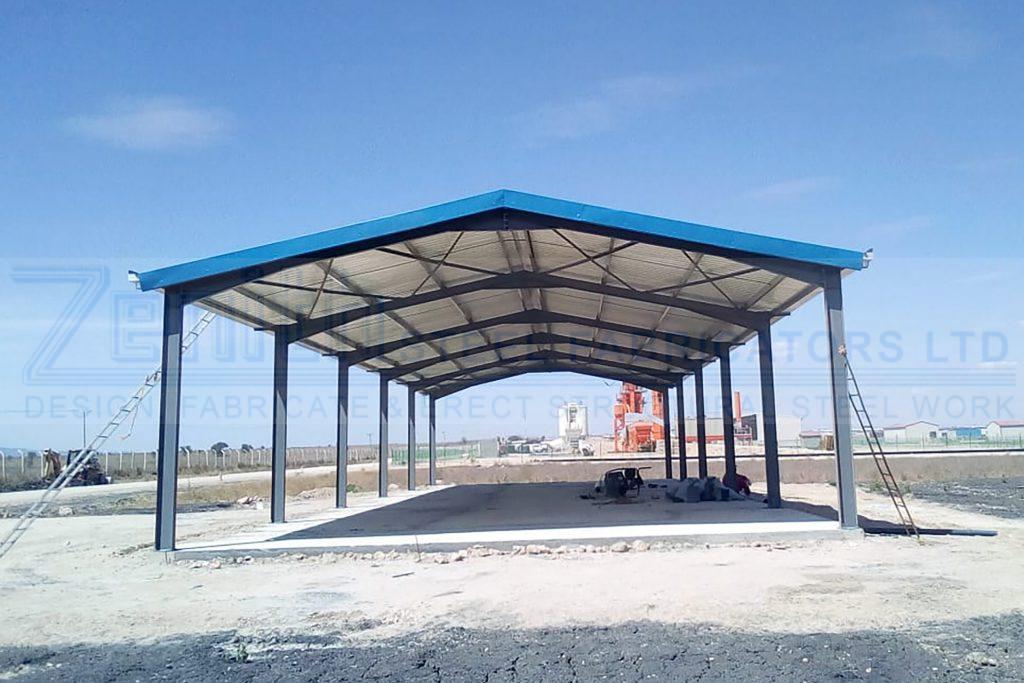
Prefabricated multi-purpose steel sheds in DRC, engineered and manufactured by Zenith Steel Fabricators, offer a fundamentally different approach. By shifting complexity off-site and simplifying on-site assembly, they enable faster deployment, predictable quality, and long-term durability.
This article outlines what decision-makers need to know, from use cases and cost drivers to design considerations and common pitfalls.
The Need for Prefabricated Structures in the DRC
Across mining, logistics, and development sectors, a clear shift is underway: prefabricated steel is replacing conventional construction as the default for remote-site infrastructure.
The core challenge
- Limited access to cement, aggregates, and construction materials
- Shortage of skilled masonry and finishing labour
- High transport costs for bulky, raw materials
- Project delays caused by weather and logistics disruptions
The prefabricated solution
Zenith Steel’s prefabricated sheds are:
- Manufactured off-site under controlled conditions
- Delivered as modular kits ready for assembly
- Installed with smaller, specialized teams
This model reduces uncertainty, a critical advantage in the DRC’s unpredictable operating environment.

Applications for Multi-Purpose steel Sheds in the DRC
Prefabricated multi-purpose steel sheds are not one-size-fits-all, they are adaptable infrastructure assets across multiple industries.
1. Mining Operations
- Equipment storage and maintenance workshops
- Secure storage for high-value machinery
- Covered workspaces to improve operational efficiency
2. Humanitarian and NGO Deployments
- Rapid-deployment storage for relief supplies
- Temporary offices and coordination hubs
- Relocatable structures for shifting operational zones
3. Logistics and Trade Infrastructure
- Transit sheds at border crossings
- Inland container depots and distribution hubs
- Weather-protected storage for goods in transit
4. Agriculture and Agro-Processing
- Post-harvest drying and storage facilities
- Processing zones for rural agribusiness
- Protection against spoilage due to rain and humidity
Across all sectors, the common advantage is the need for speed, flexibility, and durability, areas where steel outperforms traditional alternatives.
Why Steel Outperforms Traditional Construction in the DRC
- Prefabricated: All components manufactured off-site to consistent quality standards
- Transportable: Steel components are shipped flat or nested, maximizing truck load efficiency
- Fast assembly: Sheds can be erected in days to weeks, depending on size
- Durable: Galvanized steel resists the DRC’s tropical climate for decades
- Relocatable: Bolted structures can be disassembled and moved to a new location
- Minimal site infrastructure: No need for cement batching or masonry skills
Design Decisions That Directly Impact Performance
Not all steel sheds are equal. Performance in the DRC depends heavily on getting the design right from the start.
Key considerations include:
1. Size and Clear Span
- Define based on equipment, vehicles, or storage volume
- Larger clear spans reduce internal obstructions
2. Foundation Strategy
- Concrete pads for long-term installations
- Compacted gravel bases for temporary or mobile setups
3. Cladding and Roofing
- Standard steel sheeting for basic applications
- Insulated panels for temperature-sensitive operations
4. Access and Openings
- Door sizes must match operational needs (e.g., trucks, machinery)
5. Ventilation and Climate Control
- Natural airflow for storage
- Mechanical ventilation for workshops or enclosed operations
Early design optimization prevents costly retrofits and operational inefficiencies later.
Cost Factors for multi-purpose steel sheds in drc
While prefabricated steel sheds are cost-effective, total project cost depends on several variables:
- Structure size and technical specifications
- Transport distance and route complexity within the DRC
- Foundation requirements (temporary vs permanent)
- Assembly logistics and crew mobilization
- Add-ons: doors, insulation, ventilation, lighting
The biggest hidden cost is often logistics, not fabrication, especially in remote regions.
Common Mistakes That Undermine Project Success
Even with the right solution, execution mistakes can erode value.
What to avoid:
- Underestimating transport logistics to remote sites
- Using inadequate foundations for long-term structures
- Ignoring heavy rainfall patterns in roof and drainage design
- Choosing temporary structures (e.g., tents) for multi-year needs
These missteps often lead to higher lifecycle costs, impacting initial savings.
Prefabricated Steel vs Traditional On-Site Construction
For remote or infrastructure-limited sites – common across much of East and Central Africa – prefabricated steel offers significant practical advantages over traditional construction:
Factor | Prefabricated Steel (Steel Frame) | Traditional On-Site Construction (Alternative) |
Local material dependency | None – all components manufactured off-site to strict quality standards | High – dependent on local supply chain quality and material availability |
Skilled labour on site | Minimal – erection is a straightforward assembly process | Extensive – requires masons, carpenters, plasterers, and multiple trades |
Weather sensitivity | Low – assembly can continue in most weather conditions | High – rain disrupts masonry, concrete work, and finishing |
Transport to remote sites | Efficient – flat-packed components transported on standard trucks | Challenging – bulk materials are heavy and difficult to transport |
Build quality consistency | High – factory-controlled production ensures uniform quality | Variable – dependent on local labour skills and material standards |
Project speed | Fast – completed in weeks | Slow – takes months due to sequential construction stages |
Why Zenith Steel for Multi-Purpose Sheds in the DRC
Zenith Steel Fabricators builds multi-purpose steel sheds for a range of applications across 14 African countries including the DRC. With an annual capacity of 40,000 metric tonnes and experience delivering to remote locations in East and Central Africa, Zenith provides the fabrication quality and logistical capability these projects demand.
Contact Zenith Steel to discuss your shed requirements in the DRC.
Frequently Asked Questions
i) Can sheds be relocated?
Yes. Bolted steel sheds can be disassembled and reassembled at a new location, making them suitable for operations that move over time.
ii) How fast can a shed be erected?
Multi-purpose sheds can be erected on-site efficiently, with timelines depending on project scope.
iii) What foundation is needed?
Permanent installations typically use concrete pad or strip foundations. Temporary sites may use compacted gravel or engineered earth pads.
iv) How long does it take from order to first components on site?
Lead times depend on the project scope, complexity, and delivery location. Zenith Steel’s engineering team will confirm the full project schedule – from design sign-off to on-site delivery – during the project planning phase.
v) Can Zenith Steel supply both the buildings and water tanks for a remote site project?
Yes. Zenith delivers both prefabricated steel buildings and Zen Tanks water storage as an integrated package, simplifying procurement and logistics for project developers working in remote or challenging locations.