

Steel Water Tanks in Tanzania: A Strategic Solution for Agricultural Growth and Water Security
Solving Tanzania’s Water Challenge at Scale
Tanzania is one of East Africa’s most agriculturally promising yet water-constrained markets. Despite vast land resources and a growing agribusiness sector, water scarcity remains a structural challenge limiting productivity, resilience, and long-term investment.
For stakeholders, from smallholder farmers to large-scale agro-processors and development agencies, the question is no longer whether to invest in water infrastructure, but how to do so efficiently, durably, and at scale.
This is where large-capacity pressed steel water tanks in Tanzania, engineered and supplied by companies like Zenith Steel Fabricators Ltd, are emerging as a high-impact solution. Combining modular engineering, logistical efficiency, and long-term durability, these tanks address both immediate water storage needs and broader strategic development goals.
The Structural Water Gap in Tanzania’s Agricultural Economy
Agriculture remains the backbone of Tanzania’s economy, employing a majority of the population and contributing significantly to GDP. However, the sector is heavily dependent on seasonal rainfall patterns, creating a cyclical productivity challenge.
Key constraints:
- Erratic rainfall distribution leading to prolonged dry periods
- Limited irrigation infrastructure in rural and semi-arid regions
- Water-intensive agro-processing needs with inconsistent supply
- Livestock vulnerability due to unreliable water access
The result is a persistent gap between agricultural potential and actual output.
Without scalable water storage solutions, investments in seeds, fertilizers, and mechanization yield suboptimal returns. Water infrastructure is therefore a force multiplier across the entire agricultural value chain.
Why Steel water Tanks in Tanzania
The value proposition of pressed steel tanks lies in their ability to solve multiple constraints simultaneously, logistics, scale, durability, and flexibility.
a) Scalable capacity
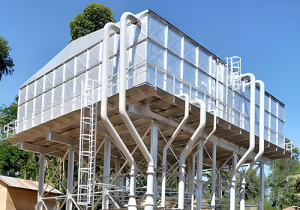
Unlike conventional plastic or concrete tanks, pressed steel panel tanks can be engineered to store hundreds of thousands to millions of litres.
Implication:
- Enables commercial-scale irrigation schemes
- Supports multi-user community water systems
- Future-proofs infrastructure against demand growth
b) Flat-pack logistics
One of the biggest challenge to infrastructure development in Tanzania is last-mile logistics. Pressed steel tanks are:
- Manufactured off-site
- Delivered as flat-packed panels
- Transported using standard trucks
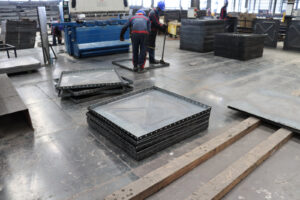
Strategic Advantage: Even remote agricultural zones become accessible without requiring specialized transport or heavy lifting equipment.
c) Durability
Steel tanks outperform alternatives in longevity and resilience:
- UV-resistant coatings prevent degradation
- Structural integrity maintained under temperature fluctuations
- Lower risk of cracking compared to concrete
With proper maintenance, these tanks deliver decades-long service life, reducing total cost of ownership.
d) Modular design
Unlike permanent concrete structures, pressed steel tanks offer operational flexibility:
- Can be disassembled and relocated
- Adaptable to evolving farm layouts or project sites
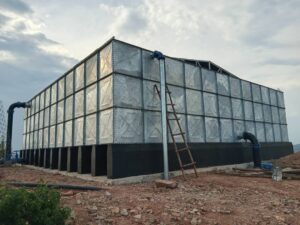
This is particularly valuable for:
- NGOs managing multiple rural projects
- Expanding agribusiness operations
Applications of steel water tanks in Tanzania
1. Irrigated farming
Steel tanks act as buffer storage systems, enabling:
- Continuous irrigation during dry seasons
- Stable crop cycles and improved yields
- Reduced dependence on unpredictable rainfall
2. Livestock water supply
Reliable water access directly correlates with:
- Improved animal health
- Higher productivity (milk, meat, breeding rates)
Strategically placed tanks ensure consistent daily supply.
3. Community water infrastructure
Development agencies and government bodies rely on centralized storage systems to:
- Store borehole or gravity-fed water
- Distribute through piped networks to households, schools, and health facilities
Steel tanks provide scalable backbone infrastructure for rural water systems.
4. Agro-processing & floriculture
Water-intensive industries, such as horticulture and food processing, require:
- High-volume, consistent water supply
- Hygienic storage conditions
Pressed steel tanks with appropriate liners meet both volume and quality requirements.
How to Specify the Right Steel Water Tank
Selecting the correct system is critical to performance and ROI.
Key decision factors include:
- Capacity Planning: Base sizing on peak demand, refill rates, and buffer requirements
- Foundation Engineering: Proper base preparation (compacted ground + concrete ring beam) is essential
- Liner Selection:
- Food-grade for potable water
- Standard liners for irrigation and industrial use
- Roofing Systems: Prevent contamination, evaporation, and algae growth
- Fittings & Accessories: Include inlet/outlet, overflow, washout, level indicators, and access hatches
- Elevation Strategy: Elevated tanks enable gravity-fed distribution, reducing pumping costs
Common Mistakes
Even high-quality systems fail when poorly specified or installed.
- Undersizing tanks based on average, not peak demand
- Inadequate foundation preparation – this is the most common cause of premature tank failure
- Using non-food-grade liners for drinking water
- Choosing plastic tanks for large-scale applications where steel is more appropriate
- Ignoring maintenance planning and inspection
Pro Tips for Maximum Impact
- Conduct a comprehensive water demand assessment before selecting tank size
- Integrate rainwater harvesting systems from nearby building roofs to supplement supply
- Schedule inspections every 2–3 years to check seals, liner condition, and fittings
- Engage local stakeholders in community-based projects to ensure the system meets actual needs
- Specify UV-resistant coatings for extended lifespan
Pressed Steel Panels vs Concrete vs Plastic Water Tanks: At a Glance
Water storage systems come in several forms. Here is how pressed steel panel tanks compare against the main alternatives for large-capacity applications:
Factor | Pressed Steel Panel Tanks | Concrete Tanks | Plastic (Poly) Tanks |
Capacity Range | Scalable to very large volumes (ideal for commercial & community use) | Very large but fixed once constructed | Limited to smaller capacities |
Delivery to Remote Sites | Flat-packed design enables transport to areas with limited road access | Requires on-site construction; material-intensive logistics | Pre-formed units are bulky and difficult to transport at large sizes |
Assembly Time | Fast on-site assembly with minimal equipment | Slow – can take weeks or months to complete | Fast, but only practical for small units |
Hygienic for Potable Use | Yes – uses food-grade internal liners | Yes – if properly lined and maintained | Depends on plastic grade and quality |
UV & Heat Resistance | Excellent – coated steel resists harsh tropical climates | Excellent – highly resistant to environmental exposure | Moderate – degrades over time under prolonged UV exposure |
Long-Term Durability | Very high with proper maintenance; decades of service life | Very high but prone to cracking if ground shifts | Moderate – becomes brittle and less reliable over time |
Why Zenith Steel for Water Tanks in Tanzania
Zenith Steel Fabricators manufactures the Zen Tanks range of pressed steel panel water tanks in Nairobi, with delivery across East Africa including Tanzania. Zen Tanks are available in a wide range of capacities and are specifically designed for flat-pack delivery and on-site assembly.
With nearly five decades of experience across East Africa, Zenith understands the logistical and environmental challenges of water storage projects in Tanzania. The company has supplied tanks for agricultural, institutional, and community projects across the region.
Contact Zenith Steel’s Dar es Salaam office to discuss your water storage project in Tanzania.
Frequently Asked Questions
i) What is the maximum capacity of a Zen Tanks steel water tank?
Zen Tanks pressed panel tanks can be configured in very large capacities. The modular panel system allows tanks to be sized to specific project needs. Capacity ranges from 5,000 – 1,000,000 litres.
ii) How long does assembly take?
A community or farm-scale tank can be assembled efficiently on-site by a trained crew. Larger tanks may take longer depending on capacity and site conditions.
iii) Are steel tanks safe for drinking water?
Yes. Steel tanks with food-grade internal liners are approved for potable water storage. The liner prevents direct contact between the water and the steel panels.
iv) Can a steel tank be relocated?
Yes. Pressed panel tanks are bolted together and can be disassembled, transported, and reassembled at a new location without damage to the panels.
v) How does Zenith deliver tanks to remote areas in Tanzania?
Zen Tanks are delivered flat-packed on standard trucks, which allows them to reach locations that would be inaccessible for pre-assembled tanks.
vi) Does Zenith Steel supply and install the tanks, or supply only?
Zenith Steel provides a complete supply, delivery, and installation service for Zen Tanks. The company’s experienced assembly teams erect the tanks on-site, including foundation preparation guidance, panel installation, and internal liner fitting.
vii) What foundation is needed for a large pressed steel tank?
Most large Zen Tanks installations use a concrete ring wall foundation or a compacted concrete pad, depending on tank size and local soil conditions. The foundation specification is provided by Zenith’s engineering team as part of the project planning process.
