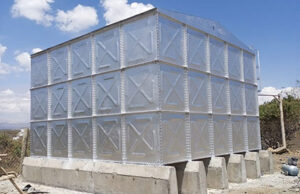
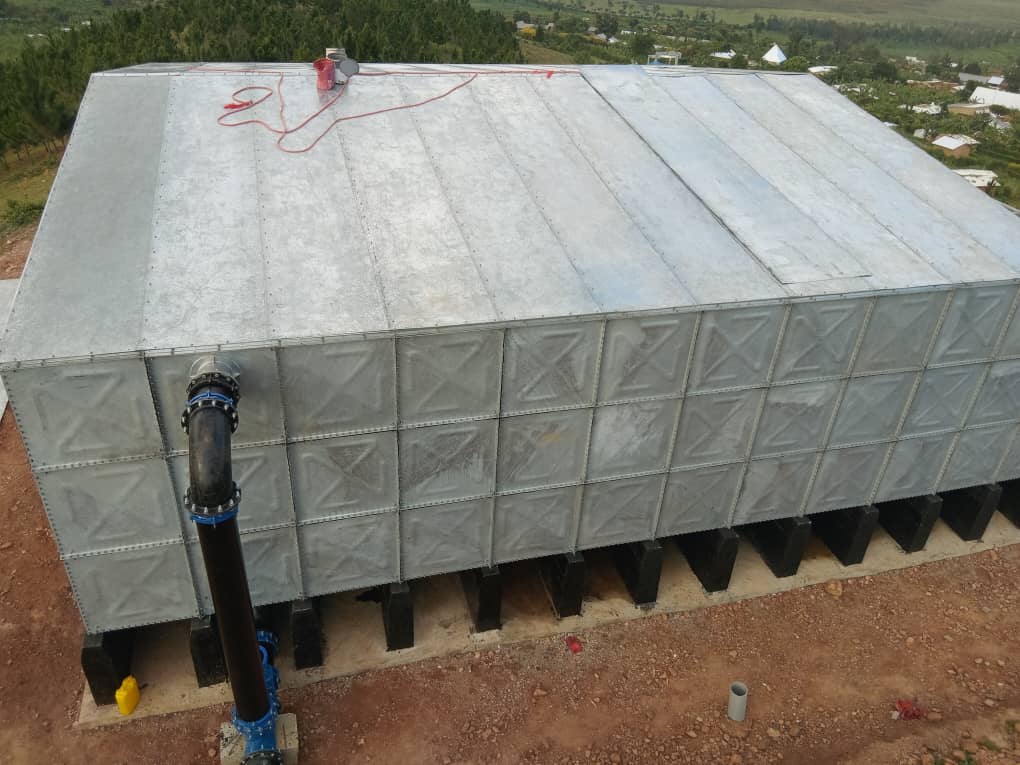
Steel Water Tanks in Malawi – Zen Tanks by Zenith Steel
Steel water tanks Malawi plant managers and water engineers specify have to answer one practical question: how do you ride out the long, hot dry months between November and April, when rainfall along the Shire Valley and the Lilongwe Plain is plentiful in season and absent out of it? For Illovo’s sugar estates, Eastern Produce tea factories, the Lilongwe and Blantyre Water Boards, donor-funded schools and the new MITC industrial parks, the working answer is a bolted sectional pressed-steel tank. Zen Tanks by Zenith Steel ship from Nairobi as flat-pack panel sets and bolt up on site, from 30 to 1,500-plus cubic metres for sugar-mill duty.
Why Bolted Sectional Steel Beats Plastic and Concrete in Malawi
Malawi’s climate stress-tests storage materials. The lakeshore corridor carries high humidity and chloride aerosol off Lake Malawi; the Lower Shire is hot, dusty and intensely sun-exposed for nine months of the year. Both regimes cut the working life of plastic and concrete. Polyethylene typically turns brittle within five to seven years under that UV load, and the diurnal thermal swing in the Shire opens hairline cracks at concrete cold joints within a decade. Bolted sectional steel water tanks Malawi engineers specify ride out both. Our standard Zen Tanks panel is 4 to 6 mm pressed mild steel, hot-dip galvanised to ISO 1461 and designed to AWWA D103-19, the operative standard for factory-coated bolted carbon steel tanks for water storage. For lakeshore sites we add a zinc-rich epoxy topcoat for a 25-year design life.
In our Malawi tank projects the shipping math also favours steel. Panels are sized to standard regional truck-bed envelopes on the Nairobi-Tunduma-Mzuzu and Mombasa-Beira-Blantyre routes, so no oversize permits are needed at the border. A 200 cubic metre Zen Tank lands as roughly 1.8 tonnes of flat-pack steel and bolts up in 5 to 7 days with a six-person crew, against 8 to 10 weeks for poured concrete of the same volume. Our Kenya Zen Tanks product family carries the same engineering into Malawi with country-specific anchoring and lakeshore coatings.

Climate, Seismic Load and the Malawi Specification
Three design cases shape every Zen Tanks order. The first is the cyclone season. Cyclone Freddy in March 2023 reached category-5 equivalent intensity and dumped 200 to 670 mm of rain over the Shire Valley in 48 hours, with Chikwawa, Nsanje and Mulanje hardest hit. For Lower Shire sites we design steel water tanks Malawi towers and panel bracing to Eurocode 1 wind annexes uplifted by 15 per cent for cyclone return-period risk.
The second is seismic load. Malawi sits along the western branch of the East African Rift, with mapped active faults under the lake bed, along the escarpment, and across the Lower Shire. We anchor tank bases and brace towers to Eurocode 8 (EN 1998, the seismic design code in operative use across sub-Saharan Africa per EAEE), with uplift factors for sites within 50 km of mapped Rift faults. On soft alluvial soils across the Shire Valley and Linthipe floodplain we specify a reinforced concrete ring beam under the panel skirt.
The third is the dispersive soil profile across the Lilongwe Plain, where clay shrink-swell can lift a poorly founded base by 30 mm in a single dry-wet cycle. Every steel water tanks Malawi order ships with an Atterberg-limits requirement before we issue final foundation drawings.
Four sectors dominate our Malawi tank book:
- Sugar estates (Dwangwa, Nchalo): 500 to 1,500 cubic metres of process water and clean-in-place storage. Illovo Sugar Malawi operates both estates and produces roughly 250,000 tonnes of sugar a year, with high water duty across crushing, refining and CIP cycles.
- Tea estates (Thyolo, Mulanje, Naming’omba): 100 to 400 cubic metres for factory withering, fermenting and drying. Eastern Produce Malawi runs the Thyolo block at 900 to 1,100 metres and the Mulanje block at 600 to 800 metres.
- Municipal water boards: 200 to 2,000 cubic metres of booster capacity for Lilongwe Water Board, which operates two plants totalling 125,000 m³/day, and Blantyre Water Board, which lifts from the Shire at Walker’s Ferry over 800 m below the city.
- Donor-funded schools and clinics: 20 to 80 cubic metres of potable storage with rainwater-harvesting tie-ins, sized to MBS drinking-water criteria.
For smallholder and commercial-farm work, our water tanks and farm storage structures for Malawi’s smallholder and commercial farms post covers the field-storage angle; this steel water tanks Malawi post focuses on industrial-grade Zen Tanks product specification and sector sizing.
Shipping, Bolt-Up and Regional Context
Every Zen Tanks delivery for Malawi leaves Nairobi as a numbered flat-pack of pressed panels, bolt sets, gaskets, coating drums and an erection booklet. Road handover is via Tunduma to Mzuzu for the Northern Region, or via Beira to Blantyre for the Southern Region. Lead time runs 6 to 8 weeks ex-Nairobi including galvanising and shop coating. We dispatch an erection supervisor for projects above 300 cubic metres or for towers over 4 metres, which cuts commissioning by two days against a self-erect crew.
A typical commissioning file for steel water tanks Malawi engineers sign off includes the mill-certificate trail, galvanising film-thickness log, bolted-joint torque chart, internal coating dry-film thickness map, hydrostatic test record at full design head, and a chlorine-flush certificate for potable duty. The same engineering discipline carries into our Malawi poultry and livestock shed builds and our multi-storey steel commercial building work. Our Namibia water storage strategic asset post sets the regional context across Southern Africa.

The five questions we put to every Malawi buyer
Across our project files, five questions decide whether steel water tanks Malawi engineers commission work over a 25-year life: the design draw across the long dry window; whether the site sits within 50 km of a mapped Rift fault; the cyclone return period for the district; the interior duty profile and matching MBS or NSF/ANSI 61 coating certificate; and who signs commissioning under Lilongwe Water Board, Blantyre Water Board, Ministry of Health or estate-engineer rules. Every Zen Tanks delivery ships with each answered in writing.
Working With Zenith Steel on a Malawi Project
To discuss a sugar-estate, tea-factory, municipal-supply or industrial-park steel water tanks Malawi requirement, contractors can reach our team via the contact page or request a quotation through the project quotation form. We respond with a panel schedule, erection timeline and delivered-to-site cost within two working days.
Frequently Asked Questions
Can Zen Tanks be tied to existing rainwater harvesting on Malawi school and clinic projects?
Yes. We supply nozzle stubs, overflow assemblies and screen filters sized to the guttering catchment area on the building. On donor-funded school projects we have linked a 50 cubic metre Zen Tank to existing classroom guttering with a first-flush diverter and a chlorine doser, all within the standard panel-set delivery.
Do Zen Tanks meet Malawi Bureau of Standards potable-water criteria?
Yes. The interior coating on our potable Zen Tanks is a food-grade epoxy certified to NSF/ANSI 61 drinking-water contact standards, which the Malawi Bureau of Standards accepts on import. Each shipment carries the manufacturer’s certificate and the as-applied dry-film thickness record for the project file.
What is the cyclone tolerance for Shire Valley and Lower Shire installations?
Tank towers for Lower Shire and Shire Valley sites are designed to Eurocode 1 wind annex with a 15 per cent uplift factor for cyclone return-period risk after the Cyclone Freddy event of March 2023. Freestanding ground tanks are inherently low-profile and resist cyclone wind well; we stiffen the tank-top skirt connection to resist gust uplift on every Lower Shire delivery.
How does Zen Tanks handle East African Rift seismic loads in Malawi?
Malawi sits along the western branch of the East African Rift. Tank base anchors and tower bracing are sized to Eurocode 8 (EN 1998), with uplift factors applied for sites within 50 km of mapped Rift faults under the lake bed, the escarpment and the Lower Shire. On soft alluvial soils we specify a reinforced concrete ring beam under the panel skirt rather than a flat slab.