

Water Storage Infrastructure for Large-Scale Projects in the Congo: The Case for Steel Tanks
Solving the DRC’s Water Infrastructure Gap
Remote operations in the Democratic Republic of the Congo face a challenge: abundant freshwater resources, yet limited infrastructure to deliver it where it is needed most. For mining companies, NGOs, and infrastructure contractors, water is not just a utility, it is a critical operational risk.
Projects in remote regions must independently source, treat, and store water, often under tight logistical and environmental constraints. In this context, water storage infrastructure becomes a strategic asset rather than a supporting component.
Steel water tanks, engineered, modular systems manufactured off-site and assembled on location, are increasingly emerging as the preferred solution. Companies like Zenith Steel Fabricators are enabling large-scale, reliable water storage tailored to Africa’s most demanding environments.
The Water Challenge in the DRC: From Abundance to Accessibility
Despite vast river systems and groundwater reserves, infrastructure limitations mean that:
- Remote sites lack piped water networks
- Water must be abstracted from rivers or boreholes
- On-site treatment systems are often required
- Storage must buffer inconsistent supply and high demand
Without reliable storage, even well-designed water sourcing systems fail to meet operational needs. Water tanks therefore serve as the critical link between supply and consumption, ensuring continuity, safety, and efficiency.
Why Pressed Steel Tanks Are the Optimal Solution
1. Logistical Feasibility in Challenging Terrain
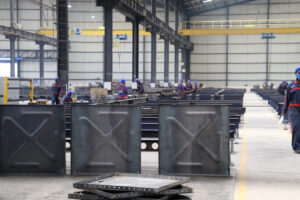
Transporting large, pre-assembled tanks across the DRC’s difficult road network is often impractical. Steel tanks solve this constraint through flat-pack delivery:
- Panels are transported using standard trucks
- Components can access remote and constrained sites
- On-site assembly eliminates the need for heavy lifting infrastructure
This modularity significantly reduces logistical risk, one of the biggest cost drivers in remote projects.
2. Scalable Capacity for High-Demand Operations
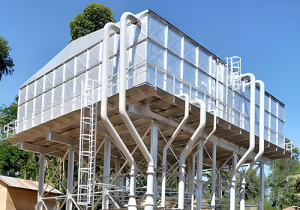
Mining camps and large-scale projects require substantial daily water reserves. Pressed steel tanks offer:
- Configurable capacities reaching hundreds of thousands of litres
- Flexibility to scale as project demands grow
- Suitability for both potable and process water storage
Unlike plastic or fiberglass options, these systems are not constrained by manufacturing size limits.
3. Engineered Durability for Tropical Conditions
The DRC’s environment presents a combination of heavy rainfall, humidity, and intense UV exposure. Steel tanks from Zenith Steel Fabricators are designed to withstand these conditions through:
- Protective coatings that resist corrosion
- Internal liners that maintain water quality
- Structural integrity under long-term environmental stress
This results in significantly lower lifecycle costs compared to alternative materials.
4. Asset Mobility and Lifecycle Value
Many remote projects, particularly in mining and humanitarian sectors, are temporary. The steel tanks provide:
- Full disassembly and relocation capability
- Reusability across multiple project sites
- Protection of capital investment over time
This mobility transforms water storage from a sunk cost into a reusable infrastructure asset.
Key Applications Across Sectors
Pressed steel panel tanks are widely deployed across high-impact sectors in the DRC:
- Mining camps (potable and process water systems)
- Humanitarian operations and field hospitals
- Infrastructure and construction project sites
- Agricultural and agro-processing facilities
- Institutional use (schools, clinics, and remote communities)
Their versatility makes them a cross-sector solution for water security challenges.
Strategic Planning Considerations
Successful deployment depends on rigorous upfront planning. Key factors include:
- Capacity Design – Align storage volume with daily demand, refill frequency, and contingency buffers. Undersizing remains a common and costly mistake.
- Water Quality Requirements – Specify food-grade liners for potable water to ensure compliance with health standards.
- Foundation Engineering – A stable base, typically a compacted surface with a concrete ring beam, is essential for structural integrity.
- System Components – Ensure inclusion of critical fittings such as inlet/outlet pipes, overflow systems, washout points, and level indicators.
- Logistics Planning – Route assessment and staging area preparation are essential given the DRC’s transport constraints.
Common Pitfalls to Avoid
Even well-funded projects can fail due to avoidable errors:
- Undersizing tanks relative to actual demand
- Not planning transport logistics for DRC road conditions
- Poor foundation preparation
- Failure to specify potable-grade materials where required
Addressing these early significantly reduces operational risk and long-term costs.
Steel Panels vs Concrete vs Plastic
Water storage systems come in several forms. Here is how pressed steel panel tanks compare against the main alternatives for large-capacity applications:
Factor | Pressed Steel Panel Tanks | Concrete Tanks | Plastic/Poly Tanks |
Capacity Range | Scalable to very large volumes | Very large but fixed once built | Limited to smaller capacities |
Delivery to Remote Sites | Flat-packed – reaches locations with limited road access | Requires in-situ construction – material-intensive | Pre-formed units are bulky and difficult to transport at large sizes |
Assembly Time | Fast on-site assembly | Slow – takes weeks or months | Fast for small units |
Hygienic for Potable Use | Yes – food-grade internal liner | Yes – if properly lined | Depends on material grade |
UV and Heat Resistance | Excellent – coated steel | Excellent | Degrades over time under tropical UV exposure |
Long-Term Durability | Very high with proper maintenance | Very high | Moderate – becomes brittle over time |
Why Zenith Steel for Water Tanks in the DRC
Zenith Steel Fabricators manufactures the Zen Tanks range with delivery across 14 African countries including the DRC. Zen Tanks are designed for flat-pack delivery and on-site assembly, making them the practical choice for remote project sites.
Contact Zenith Steel to discuss your water storage project in the DRC.
Frequently Asked Questions
i) Can Zenith deliver to remote DRC sites?
Yes. Zen Tanks are flat-packed for delivery on standard trucks. Zenith has experience managing logistics in challenging environments across Central Africa.
ii) How large can a tank be?
Zen Tanks can be configured for very large volumes. The modular system allows sizing to specific project requirements.
iii) Can tanks be moved when the project ends?
Yes. Pressed panel tanks are bolted together and can be disassembled, transported, and reassembled at a new location.
iv) Does Zenith Steel supply and install the tanks, or supply only?
Zenith Steel provides a complete supply, delivery, and installation service for Zen Tanks. The company’s experienced assembly teams erect the tanks on-site, including foundation preparation guidance, panel installation, and internal liner fitting.
v) What foundation is needed for a large pressed steel tank?
Most large Zen Tanks installations use a concrete ring wall foundation or a compacted concrete pad, depending on tank size and local soil conditions. The foundation specification is provided by Zenith’s engineering team as part of the project planning process.
