

Panel Thickness in Large-Capacity Steel Water Tanks (Malawi)

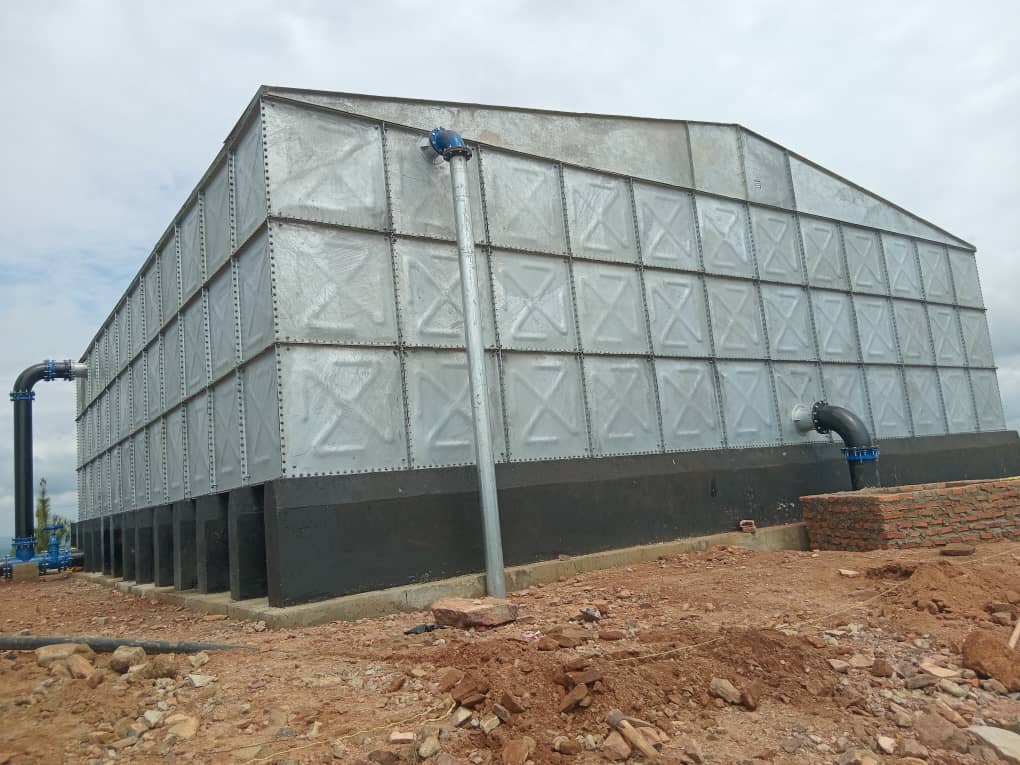
Large capacity steel water tanks Malawi engineers commission for sugar estates, tea factories and municipal reservoirs all share one design driver: panel thickness sized against depth, wind, seismic load and operational pressure cycle. Above the 500 cubic-metre threshold, panel-thickness engineering moves from optional to structural-critical, and a generic catalogue panel will not carry the duty. Zen Tanks by Zenith Steel ship CNC-pressed plates from our Nairobi works, with thickness sized from first principles for every Malawi project.

Why Panel Thickness Drives Every Large-Capacity Specification

Hoop stress on a bolted sectional tank rises linearly with stored-water depth. A 1,000 cubic-metre tank at a 6-metre fill height carries roughly twice the lower-course stress of a 500 cubic-metre tank at 4 metres, and a sugar-estate process tank that fills and drains daily adds a fatigue load that a static potable tank never sees. Our standard plate runs 4 to 6 mm at the lower courses and 2 to 3 mm at the upper courses, CNC-pressed to a controlled curvature and hot-dip galvanised to ISO 1461, the international standard for hot-dip galvanised coatings on iron and steel articles. Tank design follows AWWA D103-19, the operative standard for factory-coated bolted carbon steel tanks for water storage, with lower-course thickness uplifted for the Malawi-specific load cases set out below.

CNC-pressed plates for large-capacity steel water tanks Malawi sugar-estate delivery, hot-dip galvanised Zen Tanks panels staged at the Zenith Steel works

Malawi-Specific Engineering Variables That Shift Panel Spec

Three site factors push panel thickness above the regional default on Malawi work.

The first is seismic load. Malawi sits along the western branch of the East African Rift, with mapped active faults under the lake bed, along the western escarpment and across the Lower Shire. Tank base anchors and lower-course panels are sized to Eurocode 8 (EN 1998, the seismic design code in operative use across sub-Saharan Africa per the European Association for Earthquake Engineering), with uplift factors for sites within 50 km of mapped Rift faults. On soft alluvial soils across the Shire Valley and Linthipe floodplain we add a reinforced concrete ring beam under the panel skirt.
The second is cyclone-grade wind loading. Lake Malawi shoreline sites and Lower Shire installations have to ride out cyclone-season gusts; we design tower bracing and tank-top skirt connections to Eurocode 1 wind annexes uplifted by 15 per cent for cyclone return-period risk, on the back of the Cyclone Freddy event of March 2023 that delivered category-equivalent intensity over Chikwawa, Nsanje and Mulanje. Inland highland sites at Mzuzu or Lilongwe revert to standard wind spec.

The third is operational pressure cycling. Sugar-estate process water at Dwangwa and Nchalo fills and drains daily around the crushing and clean-in-place schedule, and tea-factory storage at the Thyolo and Mulanje blocks runs a similar diurnal pattern through the manufacturing day. Panel fatigue is the design driver for both, not peak hoop stress. We add 0.5 mm to the lower-course nominal thickness on cycle-heavy duty.

Where Panel Specification Bites Hardest on Malawi Projects

Four sectors carry most of our large-capacity Malawi tank book.

How We Size Panel Thickness on a Malawi Project

Every order ships with a panel schedule rather than a catalogue page, built from five inputs we put to the buyer. First, the maximum design fill height set against operational duty, not the tank’s geometric maximum. Second, the seismic risk based on distance to the nearest mapped Rift fault and the underlying soil profile (Atterberg limits required before final foundation drawings). Third, the cyclone return-period risk by district, with Lower Shire and lakeshore projects carrying the 15 per cent uplift. Fourth, the duty cycle: static storage, daily-fill operational tank, or intermittent process duty. Fifth, the interior coating duty: food-grade epoxy for sugar process water, NSF/ANSI 61 for potable, zinc-rich epoxy for clean industrial duty.

The output is a numbered panel schedule that runs from a 6 mm lower-course CNC-pressed plate down to a 2.5 mm tank-top course, with the cross-over rings sized against the calculated hoop stress at each course. Bolted-joint torque is specified per ring; gasket thickness is calibrated to the operating pressure band. Every order ships with mill certificates, the galvanising film-thickness log per panel, and the as-applied internal coating dry-film thickness map.

Zen Tanks panel-thickness schedule on a large capacity steel water tanks Malawi sugar-estate project, CNC-pressed plates staged for bolted sectional assembly

Shipping, Erection and the Distinct Cluster Angle

Every delivery leaves Nairobi as a numbered flat-pack of CNC-pressed panels, bolt sets, gaskets, coating drums and a site erection booklet. Road handover runs via Tunduma to Mzuzu for the Northern Region, or via Beira to Blantyre for the Southern Region and the Shire Valley. Lead time runs 7 to 9 weeks ex-Nairobi for large-capacity orders, including galvanising and shop coating. A 1,000 cubic-metre tank lands as roughly 8 tonnes of flat-pack steel and bolts up in 14 to 18 days under a Zenith Steel supervisor. The same panel-engineering discipline carries through our Malawi poultry and livestock shed builds and the wider Kenya Zen Tanks product family.

Cluster context sits in our base post on why panel thickness matters in large-capacity steel water tanks and the smallholder angle on the Malawi farm storage post.

Working With Zenith Steel on a Malawi Project

To discuss a sugar-estate, tea-factory, municipal-supply or agro-processing requirement, project teams can reach us via the contact page or the project quotation form. We respond within two working days with the calculated panel schedule, erection timeline and indicative shipping route through Tunduma or Beira.

Frequently Asked Questions

Why does Zenith uplift panel thickness for daily-fill duty on Malawi sugar-estate tanks?

Panel fatigue is the design driver on a daily fill-and-drain cycle, not the peak hoop stress. The lower-course nominal thickness lifts by 0.5 mm against the static-storage default to carry the fatigue load, and we inspect the full perimeter weld and bolt row at every panel join at commissioning. The same uplift applies to tea-factory storage at the Thyolo and Mulanje blocks, where the manufacturing-day cycle is similar.

How does the cyclone-return-period risk feed into panel and tower spec for Lower Shire sites?

Tower bracing and tank-top skirt connections for Lower Shire and lakeshore projects are designed to Eurocode 1 wind annexes uplifted by 15 per cent for cyclone return-period risk after the Cyclone Freddy event of March 2023. Freestanding ground tanks are inherently low-profile and resist cyclone wind well; the stiffened tank-top skirt connection is the principal cyclone-grade detail. Inland highland sites at Mzuzu or Lilongwe revert to standard wind spec.

What is the lead time and delivery route for a 1,000 cubic-metre Malawi tank order?

Seven to nine weeks ex-Nairobi for large-capacity Zen Tanks orders, including hot-dip galvanising and shop coating, plus 10 to 14 days in road transit. Northern Region and lakeshore deliveries run via Tunduma to Mzuzu; Southern Region and Shire Valley deliveries run via Beira to Blantyre. A 1,000 cubic-metre tank lands as roughly 8 tonnes of flat-pack panels and bolts up in 14 to 18 days under a Zenith Steel supervisor.

Leave a Reply

Your email address will not be published. Required fields are marked *