

Poultry and Livestock Shed Construction in Malawi: Why Steel Outperforms Timber and Brick
Quick answer: Tropical-climate poultry housing in Malawi works best with steel-framed sheds combining cross-ventilation, raised concrete floors, heat-managed wall cladding, and a 15-25 degree roof pitch for natural draft. Steel outperforms timber and brick because it resists humidity, scales easily, and avoids termite damage common in Malawi’s lowlands. Standard commercial sheds run 12-18m wide by 30-100m long, housing 5,000-50,000 birds depending on the system.
The Shift Toward Smarter Livestock Infrastructure in Malawi
Malawi’s livestock sector is entering a new phase of commercialization. As poultry and dairy farmers scale beyond subsistence production, infrastructure is becoming a critical driver of productivity, animal welfare, and long-term profitability.
Across the country, progressive farms are moving away from traditional timber and brick housing systems and investing in purpose-built steel poultry sheds and dairy cow barns. This shift is not just about stronger buildings, it reflects a broader operational transformation focused on biosecurity, climate resilience, faster expansion, and lower lifecycle costs.
For livestock businesses looking to improve feed conversion, reduce disease risk, and accelerate farm growth, steel structures offer a strategic infrastructure advantage. With Zenith Steel’s expertise in poultry sheds, cow barns, and agricultural steel structures across Africa, Malawian farmers can deploy scalable buildings engineered for modern livestock production.
Malawi’s Growing Commercial Livestock Opportunity
Agriculture remains the backbone of Malawi’s economy, and the country’s continued push toward private-sector growth and agricultural reform is creating strong momentum in commercial livestock production. Poultry meat, eggs, and dairy are seeing rising demand from urban populations, institutional buyers, and regional trade channels.
As farms transition from smallholder operations into medium- and large-scale commercial enterprises, housing quality increasingly determines performance outcomes such as:
- Flock mortality rates
- Milk yield consistency
- Feed efficiency
- Disease control
- Labour productivity
- Farm expansion speed
The implication is clear: livestock infrastructure is no longer a support asset, it is now a growth enabler.
Why Traditional Timber and Brick Livestock Buildings Limit Growth
Many livestock buildings in Malawi still rely on timber poles, masonry walls, and corrugated roofing sheets. While sufficient for smaller farms, these systems become operational bottlenecks at scale.
Key structural limitations include:
- High maintenance exposure – Timber remains vulnerable to termites, moisture damage, rot, and structural weakening.
- Poor ventilation performance – Brick walls trap heat and humidity, increasing heat stress and ammonia build-up, especially dangerous in poultry operations.
- Slow construction timelines – Masonry and timber builds require extended labour cycles, delaying production start dates.
- Limited expansion flexibility – Future flock or herd growth often requires costly demolition or redesign.
- Biosecurity weaknesses – Porous timber and unfinished masonry surfaces can retain pathogens between production cycles.
For commercial farms, these issues directly affect profitability.
Why Steel Livestock Sheds Are the Better Strategic Investment
1) Superior Ventilation for Poultry and Dairy Performance
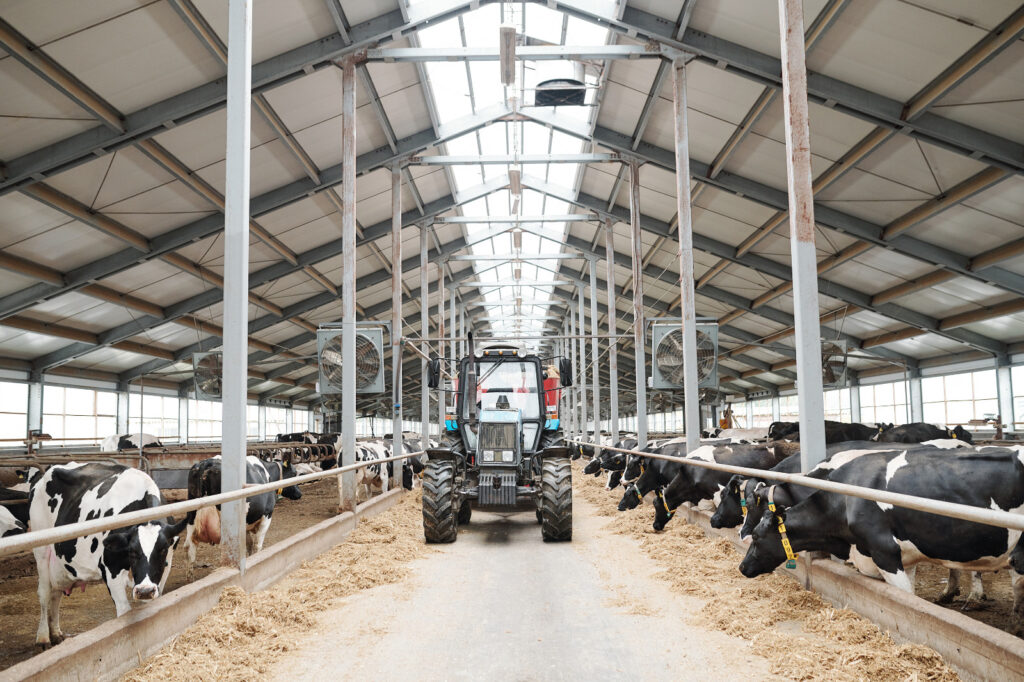
In Malawi’s warm climate, airflow is the single most important livestock design variable. Zenith Steel’s open-span steel poultry sheds and dairy barns support:
- Open-sided layouts
- Curtain wall systems
- Ridge ventilation
- High roof clearances
- Natural cross-flow airflow design
This significantly reduces:
- Heat stress
- Respiratory disease
- Ammonia accumulation
- Moisture retention
For poultry farms, better airflow translates into lower mortality, stronger FCR (Feed Conversion Ratio) performance, and improved egg production consistency.
2) Long-Term Durability in Tropical Conditions
Unlike timber, galvanized steel resists termites, fungal decay, and structural warping. This is especially valuable in Malawi’s farming environments where buildings face:
- Seasonal rains
- Intense UV exposure
- High humidity
- Biological pests
A properly fabricated Zenith Steel livestock shed delivers decades of service life with minimal maintenance requirements, reducing long-term capital replacement cycles.
3) Better Biosecurity and Hygiene Standards
Biosecurity has become a board-level issue for serious poultry and dairy operators. Steel’s smooth, non-porous surfaces make it easier to:
- Wash down walls and roof structures
- Disinfect between flocks
- Reduce bacterial harbour points
- Improve disease containment
- Maintain food-grade hygiene standards
For dairy operations, this also supports better mastitis prevention through cleaner housing conditions.
4) Faster Construction and Faster Revenue Start
One of steel’s most compelling advantages is speed. Because Zenith Steel structures are designed, fabricated, and pre-engineered off-site, installation timelines are shorter than traditional builds.
This enables farmers to:
- Stock birds sooner
- Bring dairy units online faster
- Reduce construction disruption
- Accelerate return on capital investment
In high-growth operations, time-to-production is often the biggest ROI lever.
5) Scalable Expansion for Growing Farms
Commercial farms rarely remain static. Steel sheds make it easy to:
- Add more poultry houses
- Extend dairy barns
- Create feed storage bays
- Standardise layouts across multiple farm sites
This modularity helps farms grow in phases without redesigning their entire infrastructure strategy.
Key Design Considerations for Livestock Sheds in Malawi
To maximise operational performance, farms should prioritize:
- Ventilation-first design – The most critical success factor for both poultry and dairy.
- Proper floor drainage – Especially important in cow barns to maintain hygiene and hoof health.
- Future-proof sizing – Design for projected flock or herd growth, not current production only.
- Wind-oriented positioning – Align buildings with prevailing winds to optimize passive cooling.
- Integrated feed and water systems – Ensure feeders, drinkers, and milking routes fit the daily workflow.
Steel Livestock Shed Cost Drivers in Malawi
The total project cost depends on several factors:
- Building width and span
- Roofing and cladding specification
- Floor finish and drainage systems
- Curtain wall accessories
- Feeders and drinker integration
- Transport logistics into Malawi
- Erection and site preparation
The more important metric, however, is total cost of ownership rather than upfront price. Steel consistently outperforms timber when measured across:
- Maintenance cost
- Lifespan
- Replacement cycles
- Downtime risk
- Disease prevention value
Common Mistakes Farmers Should Avoid
The most common capital planning mistakes include:
- Choosing timber based only on upfront price
- Underestimating ventilation requirements
- Building for today’s herd only
- Poor drainage detailing
- Ignoring biosecurity wash-down needs
The result is usually higher operating costs disguised as “cheaper construction.”
Steel vs Timber vs Masonry for Livestock Housing
Before committing to a construction method, here is how steel compares against the two most common alternatives for livestock housing in East Africa:
Factor | Steel Frame | Timber | Masonry |
Construction speed | Fast – erected on-site in weeks | Moderate | Slow – months of bricklaying |
Durability | Very high – resists termites and rot | Low – vulnerable to termites and rot in tropical climates | High wall strength, but timber roof trusses remain a weakness |
Ventilation design | Fully customizable – open-span, ridge vents, curtain walls | Limited by structural walls | Limited by structural walls |
Future expansion | Easy – add bays without major disruption | Difficult | Very difficult and expensive |
Pest resistance | Termite- and rodent-resistant | High risk – requires ongoing treatment | Walls are resistant, but roof structure remains vulnerable |
Total cost of ownership | Lower over the life of the building | Higher due to maintenance and replacement | Moderate |
Why Zenith Steel for Livestock Buildings in Malawi
Zenith Steel Fabricators builds poultry sheds, cow barns, and multi-purpose farm sheds for delivery across 14 African countries including Malawi. With nearly 50 years of experience fabricating steel structures across East Africa, Zenith provides livestock housing designed for the region’s specific climate and farming conditions.
Contact Zenith Steel to discuss your farm building project in Malawi.
Frequently Asked Questions
i) Is steel more expensive than timber in Malawi?
Steel has a higher upfront cost but lasts three to five times longer with less maintenance. The total cost of ownership over 20 years strongly favours steel.
ii) Can Zenith deliver to Malawi?
Yes. Zenith Steel serves Malawi.
iii) How quickly can a shed be built?
Project timelines depend on the scope, size, and site conditions of your project. Our engineering team will provide a detailed schedule during the planning phase.
iv) Does Zenith Steel design the barn layout, or do we need to provide plans?
Zenith Steel’s engineering team handles the full design process, from site assessment to structural drawings. Farmers and investors provide their operational requirements – herd size, functional zones, site access – and Zenith’s team develops a building solution around them.
v) Can a steel barn be built in phases as the farm grows?
Yes. One of the key advantages of steel construction is that additional bays can be added to the existing structure as the herd expands, provided the original design allows for future extension. Planning for phased growth from day one keeps future expansion costs low.
Frequently Asked Questions
How do you design poultry housing for Malawi’s tropical climate?
Tropical-climate poultry housing in Malawi requires cross-ventilation through open-sided walls, raised concrete floors to manage moisture, heat-managed wall cladding (insulated panels or shade netting), and a 15-25 degree roof pitch for natural draft cooling. Steel framing is preferred because it resists humidity and termite damage common to Malawi’s lowlands.
What’s the best size for a commercial poultry shed in Malawi?
Standard commercial sheds in Malawi range from 12-18m wide and 30-100m long, housing 5,000-50,000 birds depending on the housing system. Layer houses typically run smaller (5,000-10,000 birds) while broiler houses scale larger (20,000-50,000 birds per cycle).
Why is steel better than timber or brick for poultry sheds in Malawi?
Steel outperforms timber and brick in Malawi for three reasons: it resists humidity-driven rot and termite damage (timber’s main failure mode), it scales easily for expansion, and it allows cleaner biosecurity protocols because seams can be sealed and surfaces washed down. Steel sheds last 25+ years with basic maintenance, while timber typically needs replacement within 8-10 years.
How long does it take to build a steel poultry shed in Malawi?
A standard 1,000 square metre steel poultry shed takes 6-10 weeks from order to handover, including design, fabrication in Kenya, shipping to Malawi, and on-site assembly. Larger projects above 3,000 m2 take 12-16 weeks.
What biosecurity features should a Malawian poultry shed include?
Modern poultry shed biosecurity in Malawi includes vehicle wash-down at entry, foot baths at each shed door, sealed eaves to prevent wild bird ingress, vermin-proof drainage, separated dirty and clean traffic flows, and washable interior surfaces. Steel construction makes each of these easier to implement than timber.
What’s the difference between layer house and broiler house design?
Layer houses (egg production) typically use cage or aviary systems with feeding lines and laying nests, requiring 12-15m widths and 1,500-2,500 m2 footprints. Broiler houses (meat birds) are open-floor with feeding/drinking lines, scaling to 18m widths and 3,000-5,000 m2 footprints. Both benefit from steel framing for biosecurity and longevity.
Can Zenith Steel deliver poultry sheds outside Malawi’s main cities?
Yes. Zenith Steel ships flat-pack steel poultry sheds across Malawi including Lilongwe, Blantyre, Mzuzu, and rural farming districts. Components are designed for road transport and on-site assembly, so remote farms in Mchinji, Salima, and Karonga are routinely served.