

Pre-Engineered Buildings (PEBs) in DRC: Warehouses, Factories and SEZ Sheds

Pre-engineered buildings in DRC answer a single commercial question: how do you get 3,000 square metres of weatherproof floor space onto a Congolese site, on schedule, when wet-trade labour is scarce and the rainy season is closing in? The country’s industrial build-out runs on four nodes: mining-supply warehousing along the Lubumbashi-Kasumbalesa belt, FMCG distribution centres around Kinshasa’s Kingabwa and Limete industrial zones, agro-processing factories in Kasai and Tshopo, and port-side bonded sheds at Matadi and Boma. Zenith Steel designs, fabricates and ships PEB packages into the DRC as flat-pack bolted steel, sized to the duty class and ready to erect on a concrete pad.

Why PEBs Out-Perform Conventional Construction in DRC

Three site-level constraints shape the DRC PEB case. Kinshasa humidity sits above 75 per cent year-round, the long rainy season runs roughly October to May, and skilled wet-trade labour is scarce on remote mining and agro-processing sites. Those three factors push reinforced-concrete build programmes 50 to 70 per cent longer than the equivalent PEB schedule. A bolted steel kit erects in any weather window between storms, ships pre-coated, and demands a rigging crew rather than formwork carpenters and rebar fixers.

Our DRC PEB packages run through Tekla detailing in Nairobi, fabricate to BS EN 1090-2 execution class EXC2 or EXC3, hot-dip galvanise to ISO 1461, and ship pre-painted in an epoxy topcoat. On site, the building bolts up off a numbered erection drawing: no on-site welding, no wet trades beyond the slab. Wind loading on DRC builds follows the methodology of Eurocode 1 part 1-4 actions on structures, wind actions, with basic wind velocity set against site-specific meteorological data because the DRC has no national annex of its own.

Zenith Steel pre-engineered buildings DRC fabrication shop preparing primary steel for a Lubumbashi PEB shipment

DRC PEB Use Cases We Have Sized For

In our DRC PEB enquiries, the use case decides the structural geometry before the architectural finish is discussed. Four configurations cover roughly 90 per cent of the active demand:

  • Mining-supply warehouses on the southern copper belt at Kolwezi and Likasi: 1,500 to 5,000 square metre floor area, 8 to 12 metre roof eave height, rated for an overhead travelling crane on the primary portal frames. End users are the supply-chain operators feeding Kamoto Copper Company, Metalkol RTR and the wider Lualaba and Haut-Katanga mining base.
  • FMCG distribution centres in Kinshasa’s Kingabwa and Limete belt and inside the 885-hectare Maluku Special Economic Zone: 2,000 to 8,000 square metre high-bay sheds with insulated roof panels and a vapour barrier for tropical-climate temperature control.
  • Agro-processing factories in Kasai (the country’s main cassava heartland) and Tshopo (the coffee-growing belt around Kisangani): 800 to 2,500 square metres with food-grade interior wall panels, hygienic floor coving and ventilation matched to the process flow.
  • Port-side bonded sheds at Matadi and Boma on the lower Congo River: 1,000 to 3,000 square metres with tropical-rated insulation, cross-ventilation louvres and a clear span for container handling under cover.

For the wider PEB rationale and a Nairobi reference build, see our cluster post on why pre-engineered buildings are taking over the construction sector. The mining-operations storage angle sits on our DRC warehouse and racking for mining and industrial operations post, and remote-site shelter cases sit on our steel multi-purpose sheds for remote DRC sites guide.

Engineering Spec for the DRC Climate and Mining Belt

Two environmental loads define the spec we ship. Kinshasa, Matadi and the Congo Basin north of Lubumbashi all sit in a high-humidity, high-rainfall band that strips thin paint finishes inside two wet seasons. Our DRC PEB default is hot-dip galvanising of primary and secondary steel to ISO 1461, followed by an epoxy or polyurethane topcoat. Cladding and roof sheeting ship pre-coated in PVDF or SMP-finished steel for ultraviolet resistance, with insulated roof panels on agro-processing and FMCG builds where interior temperature stability matters.
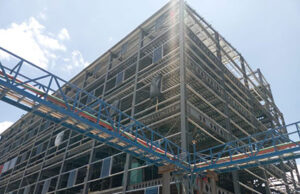
The second load is dust. Along the Lubumbashi-Kasumbalesa corridor and around the Kolwezi mining belt, copper-belt road dust and tailings fines abrade thin finishes and pack into shallow connection details. We specify sealed bolted connections, capped column bases and self-cleaning roof pitches of 1:10 minimum, with no horizontal ledges that hold abrasive fines. The galvanising film-thickness log ships with each consignment so the client’s QA officer can audit against ISO 1461.

Seismic loading is a lighter case than imported templates suggest. The southern DRC, including Lubumbashi and the wider Katanga plateau, sits in the low-hazard zone on the published DRC seismic hazard mapping on ThinkHazard; active rift seismicity sits north and east, around Lake Kivu, Lake Tanganyika and the Ruwenzori range. Standard portal-frame anchorage with M20 chemical or mechanical anchors into a sound 250 millimetre slab is sufficient for the copper belt. Enhanced bracing and uplift detailing is engineered only where the site is mapped within 50 kilometres of an active rift fault.

Shipping, Customs and Erection on a DRC Site

Lead time from a confirmed PEB purchase order to a bolt-ready delivery at site runs 12 to 16 weeks ex-Nairobi, including Tekla detailing, fabrication, galvanising and transport. For Lubumbashi and the copper belt, our standard transit is overland Nairobi, Namanga, Dar es Salaam, Tunduma, Kapiri Mposhi, Kasumbalesa, Lubumbashi. For Kinshasa, Maluku SEZ and Matadi orders, sea freight to the port of Matadi via Dar es Salaam or Durban is the default, with the Lobito corridor through Angola tracked as a credible alternative as that route matures.

DRC customs paperwork follows a specific list. Every PEB shipment leaves with a Bureau Veritas BIVAC certificate of inspection issued before loading, the OGEFREM FERI maritime freight document for sea legs, and the OCC declaration prepared in French for clearance at the port or border. Documents are issued bilingually to match the OFIDA and OGEFREM rule that all import dossiers be filed in French. Clearance at Kasumbalesa runs 5 to 10 working days; for Matadi-bound containers we budget 14 to 21 days for the port window.

Zenith Steel pre-engineered buildings DRC primary portal frame staged for erection on a Lubumbashi mining-supply site

On-site erection of a 2,000 square metre single-aisle PEB runs 6 to 8 weeks for an eight-person crew working from numbered erection drawings, slab anchor templates and stamped engineering calculations. We dispatch a Nairobi-based supervisor on every DRC PEB above 1,500 square metres, paired with a locally hired rigging crew. Each delivery includes mill certificates, the galvanising log, the bolt-tension torque schedule, the stamped engineer’s design package and the post-erection inspection checklist for the client’s safety officer file.

To start a specification, reach our DRC desk via the contact page or the project quotation form.

Frequently Asked Questions

What is the typical PEB lead time to a DRC site?

Twelve to sixteen weeks ex-Nairobi, covering Tekla detailing, fabrication to BS EN 1090-2, hot-dip galvanising to ISO 1461 and overland or sea transit. Overland to Lubumbashi via Dar es Salaam, Tunduma, Kapiri Mposhi and Kasumbalesa runs 14 to 21 days; sea routing to Matadi for Kinshasa and western DRC orders runs three to four weeks plus port clearance.

Does Zenith Steel provide an erection crew for DRC PEB sites?

Yes. On projects above 1,500 square metres we dispatch a Nairobi-based erection supervisor for the full build, working with a locally hired rigging crew. Smaller builds ship with numbered erection drawings and remote supervisor support for the client’s own crew.

How does the design handle wind and seismic loading in the DRC?

Wind loading follows the methodology of Eurocode 1 part 1-4, with basic wind velocity set against site-specific meteorological data because the DRC has no national annex of its own. Seismic loading is light across the southern copper belt and Katanga plateau, which sit in the low-hazard zone on the published DRC seismic hazard mapping. Enhanced bracing is engineered for sites within 50 kilometres of an active rift fault.

Leave a Reply

Your email address will not be published. Required fields are marked *