Steel Detailing Services in South Sudan: AutoCAD & Tekla
Steel detailing services in South Sudan decide whether a truckload of fabricated steel bolts together on the first try in Juba or waits at the roadside for a re-cut beam. In our South Sudan project deliveries, every column, beam, gusset and base-plate is modelled in Tekla Structures and cross-checked in AutoCAD before any plate is cut. Zenith Steel runs that workflow from its Nairobi engineering office, with site liaisons in Juba.
Why South Sudan Detailing Has to Be Right First Time
Two constraints push the workflow toward zero on-site rework. First, the Mombasa-to-Juba haul runs the full Northern Corridor, typically 10 to 14 days through Malaba, Kampala and Nimule. A single missing gusset can pause a build for three weeks. Second, qualified welders, replacement plate stock and calibrated NDT kit are scarce outside Juba, so any joint that cannot be field-bolted with a torque wrench is a programme risk.
The structural backbone combines BS EN 1993 (Eurocode 3) for design, BS EN 1090 Execution Class 2 or 3 for fabrication, ISO 9001 quality management, and hot-dip galvanising to ISO 1461. Material is then certified through the South Sudan National Bureau of Standards (SSNBS), which has held the conformity-assessment mandate since the SSNBS Act 2012 and inspects construction imports at Nimule. A dossier laid out in SSNBS inspector order clears the border in a working day rather than three.

Tekla and AutoCAD Workflow for South Sudan Projects
Our South Sudan workflow follows a fixed sequence. The Tekla model goes up first, full 3D with every connection, bolt, stiffener and base-plate. Clash detection runs against the architect and MEP models before any fabrication drawing is released. AutoCAD then handles civils interfaces, embedment plates and rebar coordination for the foundations the local contractor will pour. The link is intentional: Tekla exports IFC for BIM coordination, while AutoCAD carries setting-out dimensions the site team can read with no Tekla viewer on a Juba laptop. For more on that pairing on East African projects, see our AutoCAD and Tekla precision detailing post.
For every steel detailing services South Sudan project we deliver:
- Full 3D Tekla Structures model with clash detection against architect and MEP federations
- Auto-generated single-part and assembly drawings issued in erection sequence order
- CNC NC1 files for plate processing, drilling and coping
- Tagged piece-mark register so every member matches the truck manifest and the cut list
- Bolt and consumables BOM cross-checked against the dimensional QA report
- IFC export for BIM coordination plus PDF and DWG sets for site use
Connection Strategy: Bolt First, Weld Only in the Shop
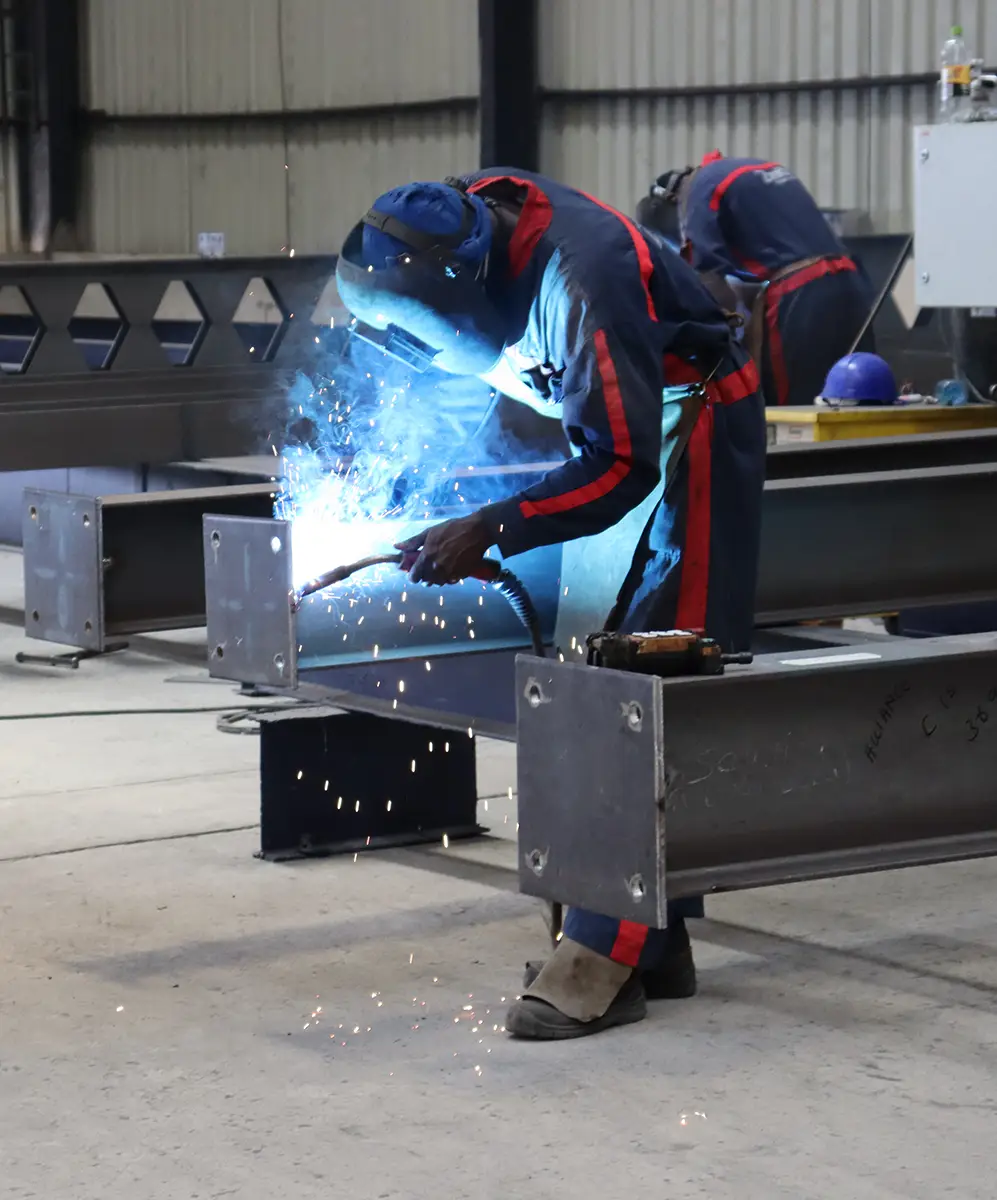
Because skilled welders are 1,500 km away by road and field power is patchy outside Juba, our Tekla model prefers bolted connections wherever the structural action allows. End-plate beam-to-column joints are shop-welded and shipped as single members. Splices, brace nodes and purlin cleats are bolt-only. Moment connections, where unavoidable, use bolted extended end-plates with pre-tensioned high-strength bolts to ISO 4017 / EN 14399. The result is a structure a Juba site team can erect with a torque wrench, a man-lift and a competent foreman, with no field welding generator on the truck list. We apply the same bolt-first discipline across our wider structural steelworks programme for commercial, residential and industrial projects.
Corrosion is the other constraint. South Sudan swings from a six-month rainy season (May to October on the Bahr el Ghazal and Upper Nile floodplains) to a long dry season with daytime temperatures over 40 degrees Celsius. Every member ships hot-dip galvanised to ISO 1461 by default, with a zinc-rich epoxy topcoat for prolonged ground-contact exposure such as fuel-bund frames and pipe-rack baseplates on oil-field sites.
Oil-Field Detailing: Bentiu, Paloich and the Upper Nile Blocks
The oil-producing belt, principally Unity State around Bentiu and Upper Nile State around Paloich, accounts for the bulk of national crude. Detailing for this belt differs from a Juba warehouse in one respect: hazardous-area compliance. Process-side service buildings are classified as IECEx hazardous areas, typically Zone 1 or Zone 2 depending on proximity to well-head, separator or storage tank.
Our Tekla model carries those implications through to fabrication. Earthing bosses for lightning protection are detailed and shop-welded. Cable-tray support cleats are pre-drilled so electricians can mount explosion-proof junction boxes without drilling galvanised members on site (which would compromise the coating). Stair stringers and handrails suit anti-static walking surfaces, and every primary member carries a piece-mark the operator’s HSE auditor can read against the as-built drawing.
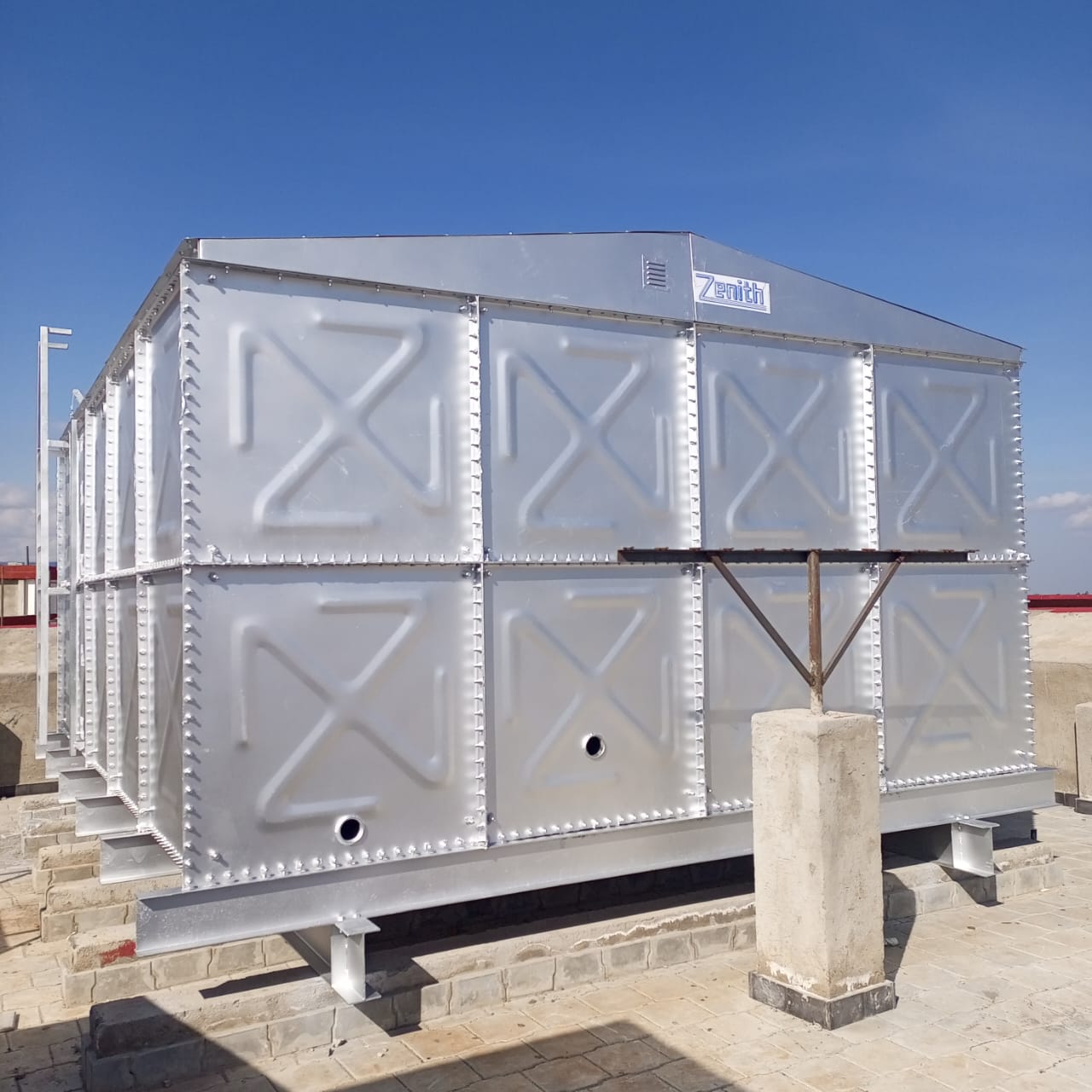
For donor-funded and civilian work, the discipline is the same. School and clinic frames across Greater Equatoria, market warehouses in Juba and Wau, and the prefabricated bays we ship regionally all run off the same Tekla-first sequence. These builds feed our cluster of posts on water tanks and steel sheds for South Sudan infrastructure, steel church buildings for South Sudan’s growing communities, and prefabricated steel structures for South Sudan.

Logistics: Cutting to Truck-Bed Envelope
The Mombasa-to-Juba route via Nairobi, Eldoret, Malaba, Kampala and Nimule is roughly 1,800 km of mixed tar and gravel. Northern Corridor truck-bed envelopes allow members up to 12 metres without an oversize permit. Our rule is to cut every column and primary beam inside that envelope, splicing on site at bolted joints where the structural action allows. Where a span genuinely needs to ship as a single 14 to 18 metre member, we coordinate the oversize permit and escort out of Nairobi. The Tekla model carries the truck plan as a phase, so the drawing set the fabricator cuts to is the one the dispatcher loads to.
SSNBS inspection at Nimule travels with a pre-formatted dossier: mill certificates, fabrication QA, weld procedure log, dimensional report, HDG film-thickness readings and the piece-mark register. In our South Sudan deliveries since 2018, it has cleared Nimule inside a working day on every load.
The Bottom Line for South Sudan Steel Buyers
Steel detailing services in South Sudan come down to one test: does what arrives on site bolt together without a welder. The answer turns on three habits set during detailing: bolt-first connections, truck-envelope cut lengths, and an SSNBS-ready dossier in inspector order. Zenith Steel folds all three into one package. If you are scoping a Juba, Wau or oil-field project and want a fixed-price detailing and fabrication quote, use our contact page or the project quotation form.
Frequently Asked Questions
Does Zenith Steel deliver detailing and fabrication as one package for South Sudan projects?
Yes. Tekla and AutoCAD detailing, BS EN 1090 fabrication, hot-dip galvanising and Mombasa-to-Juba shipping are all coordinated from our Nairobi works under a single contract, with site liaison in Juba.
Which software outputs does the client receive for a South Sudan job?
Tekla IFC for BIM coordination, AutoCAD DWG for civils interfaces, PDF fabrication and assembly drawings, CNC NC1 files for the fabricator, and a tagged piece-mark register that ties to the truck manifest.
How does Zenith Steel handle SSNBS inspection at the Nimule border?
Every load travels with a delivery dossier pre-formatted to SSNBS conformity-assessment criteria: mill certificates, fabrication QA, weld map, dimensional report, HDG film-thickness readings, and the piece-mark register. The dossier typically clears Nimule in a single working day.
What corrosion specification do you use for South Sudan oil-field buildings?
Hot-dip galvanising to ISO 1461 is the default on every member. For pipe-rack baseplates, fuel-bund frames and any prolonged ground-contact exposure on Unity and Upper Nile sites, we add a zinc-rich epoxy topcoat.
What is the typical detailing lead-time for a South Sudan warehouse or oil-field service building?
Three to five weeks of Tekla and AutoCAD detailing for a mid-size warehouse, four to six weeks for an oil-field service building with hazardous-area coordination, depending on architect and MEP turnaround.