Steel Detailing Services in Tanzania: AutoCAD & Tekla

Steel detailing services in Tanzania sit at the centre of every successful steel project, from a Dar es Salaam port shed to a Dodoma government block. The discipline blends Tekla Structures 3D modelling with AutoCAD 2D shop drawings, BS EN 1090 fabrication codes, and Tanzania Bureau of Standards (TBS) acceptance criteria. In our Tanzania project work, the quality of the detailing decides whether a column lands clean on its bolts the first time, or whether the crane sits idle while a member is re-cut.

Why Tanzania’s Steel Sector Runs on Tekla and AutoCAD

Tanzania’s construction calendar is one of the busiest in East Africa. The Standard Gauge Railway stations along the Dar-Morogoro-Dodoma axis, the Bagamoyo Special Economic Zone development, the Mtwara port expansions, and the steady pipeline of commercial work in Dar es Salaam’s Kurasini and Mlimani industrial zones all sit on structural steel. The structural tolerance on these jobs is unforgiving. Coastal humidity in Dar es Salaam averages 78% across the year, and the Indian Ocean salt aerosol means a single misaligned bolt hole becomes a corrosion pit inside eighteen months. That climate context is what Tanzania detailing has to answer to. Accuracy has to hold from the Tekla model right through to the last bolt torque on site.

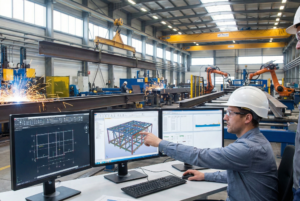
Tekla Structures, developed by Trimble, is the BIM-grade modelling platform behind almost every serious Tanzania steel job. The 3D model carries the full intelligence of the build: clash detection, fabrication drawings, CNC nesting files, and a coordinated handover to the architect and the MEP consultants. AutoCAD by Autodesk remains the working format for civils interfaces and embedment plates, because Tanzanian main contractors still standardise on 2D shop drawings for base-plate setting out and for grout-pocket dimensions. In our Tanzania project work, we run both tools in parallel: Tekla as the source of truth, AutoCAD as the field-ready issue.

For every Tanzania project our detailing team delivers a defined output set:

  • Full 3D Tekla model with clash detection complete
  • Auto-generated fabrication drawings and CNC NC files for the workshop
  • Assembly drawings issued in erection-sequence order
  • BIM-coordinated handover to the architect and the MEP team in IFC
  • Bill of materials traceable back to the mill certificate

This is the same workflow described in our parent post on how AutoCAD and Tekla improve precision in steel fabrication. The Tanzania application adds two layers: the TBS dossier and the coastal corrosion default.

How the Tekla Workflow Plays on a Dar es Salaam Project

Most Tanzania jobs run on tight customs windows. The steel has to clear Dar es Salaam port, transit through Vigwaza, and reach the site without rework. Our Tekla model is built so the delivery sequence matches the erection sequence. The first batch carries columns and base plates. The second batch is primary beams. The third covers purlins, cleats and bracing. This batching, all driven from one Tekla model, keeps the erection crane working and stops the site team from chasing a missing piece across the port. Crews on site need parts arriving in the right order, with the right tags, on the right truck.

Tekla-modelled structural steel sections prepared for a Tanzania steel detailing services delivery

TBS Inspection and the Delivery Dossier

The Tanzania Bureau of Standards (TBS) inspects imported and locally fabricated structural steel at the port and on site. Every Zenith Steel delivery into Tanzania travels with a pre-formatted TBS dossier: mill certificates, fabrication QA report, weld map, dimensional report, and hot-dip galvanising film-thickness readings. The dossier is laid out in the order a TBS inspector reads it, so the load clears port within the standard customs window. We use this same dossier discipline across our structural steelworks practice for commercial and industrial projects, with the Tanzania-specific section adapted for TBS rather than the Kenya KEBS template.

BS EN 1090, the conformity assessment standard for structural steel components, is the technical anchor that TBS recognises. Our fabrication runs to BS EN 1090 Execution Class 2 or 3 depending on the project, and the CE-equivalent paperwork is built into the dossier. The fabrication is also covered by ISO 9001 quality management and AWS D1.1 welding qualification, so every weld procedure on a Tanzania project ties back to a qualified welder card. From our project notes, this combined stack has cut TBS clearance time on a typical 200-tonne consignment by roughly two working days versus an undocumented competitor load.

Coastal Climate and Connection Design

Dar es Salaam coastal projects, Mtwara port work, and Bagamoyo SEZ sheds all sit inside a chloride-rich aerosol band. Tanzania coastal builds need the corrosion regime specified from the model up, not as a paint-shop afterthought. By default we ship every Tanzania-bound member hot-dip galvanised to ISO 1461, with an additional zinc-rich epoxy topcoat for splash-zone members. The Tekla model carries the coating spec on every part mark so the workshop applies the right system before despatch.

Connection design also shifts on Tanzania coastal jobs. We prefer fully bolted moment frames where the design allows, with end-plate connections shop-welded and field-bolted. Field welding on a humid coastal site is harder to control, so the Tekla model is built to keep weld work in the workshop where humidity is managed. This is the same logic applied to our multi-storey steel buildings programme for Dar es Salaam developers, where bolt-only erection keeps the tower programme on schedule even through the long rains.

Where Detailing Plugs Into the Wider Tanzania Cluster

The steel detailing services Tanzania contractors order from us rarely sit alone. The Tekla model usually feeds adjacent work: warehouse construction and pallet racking for Tanzania logistics operators, water storage for industrial parks under our Tanzania steel water tanks programme, and the structural steelworks line itself. Carrying one BIM model across these scopes saves the client a duplicate co-ordination cycle and keeps the as-built drawings consistent across the project.

Zenith Steel workshop preparing fabricated members for Tanzania steel detailing delivery

From our Tanzania project notes, three operational details earn the most attention from main contractors. First, the Tekla IFC export shared with the MEP consultant before fabrication begins, which catches duct-versus-beam clashes weeks before the crane arrives. Second, the part-mark labelling system, which uses a colour-coded tag that survives the port handling and the Dar es Salaam dust. Third, the daily shop-floor traceability log, which lets us pull any part-mark back to its mill heat number inside thirty seconds during a TBS query. The steel detailing services Tanzania jobs depend on are the ones that survive scrutiny on the day of inspection, not just on the drawing board.

The Bottom Line for Tanzanian Contractors and Developers

Steel detailing services in Tanzania come down to one practical test: does what arrives on site match the model. The steel detailing services Tanzania developers should specify are the ones with a clean Tekla-to-shop-floor audit trail and a TBS-ready dossier on the truck. Our Tekla and AutoCAD workflow is built so that match holds every time, on every Tanzania job, from a single shed in Bagamoyo to a multi-tonne SGR station programme. If you are planning a Dar es Salaam, Dodoma or Mtwara project, please use our contact page or request a fast quotation through the project quotation form.

Frequently Asked Questions

Does Zenith Steel deliver detailing, fabrication and shipping as one package for Tanzania projects?

Yes. Detailing, fabrication, hot-dip galvanising, and road shipping are coordinated from our Nairobi works to any Tanzania site, with TBS-ready paperwork attached to each delivery.

What software outputs does the client receive on a Tanzania steel detailing project?

The client receives the Tekla IFC model for BIM co-ordination, AutoCAD DWG shop drawings, PDF fabrication drawings, CNC NC files for the workshop, and a fully indexed bill of materials.

How does Zenith Steel handle TBS customs and on-site inspection?

Our delivery dossier is pre-formatted to TBS criteria. It carries mill certificates, fabrication QA, weld map, dimensional report, and galvanising film-thickness readings, so the load clears the port within the standard customs window.

What is the typical detailing lead time for a Tanzania project?

Three to five weeks for a mid-size warehouse or shed, four to six weeks for a multi-storey commercial frame, depending on architect and MEP coordination cycles.

Which corrosion specification do you use for coastal Tanzania projects?

Hot-dip galvanising to ISO 1461 is the default. For Dar es Salaam, Mtwara and Bagamoyo splash-zone members, we add a zinc-rich epoxy topcoat for extended service life under chloride exposure.

Leave a Reply

Your email address will not be published. Required fields are marked *