

Ethiopia’s diverse geography presents unique challenges for water storage infrastructure. From the high-altitude conditions of Addis Ababa and the surrounding highlands to the hot, arid regions of the Rift Valley, storage systems must withstand significant temperature fluctuations, intense UV exposure, and varying environmental conditions throughout the year.
These factors can accelerate the deterioration of conventional storage solutions. Plastic tanks may become brittle after prolonged exposure to harsh sunlight, while concrete structures can develop cracks over time due to thermal expansion and contraction. For organizations seeking long-term reliability, these maintenance challenges often translate into increased operational costs and reduced service life.
Steel water tanks offer a more durable and future-ready alternative. Zenith Steel’s Zen Tanks are engineered using high-quality pressed steel panels (4 to 6 mm pressed mild steel) with advanced corrosion protection systems, delivering exceptional structural strength and long-term performance in demanding environments. Designed to meet internationally recognized standards, these tanks provide reliable storage for potable water, irrigation systems, industrial processes, and commercial developments across East Africa.
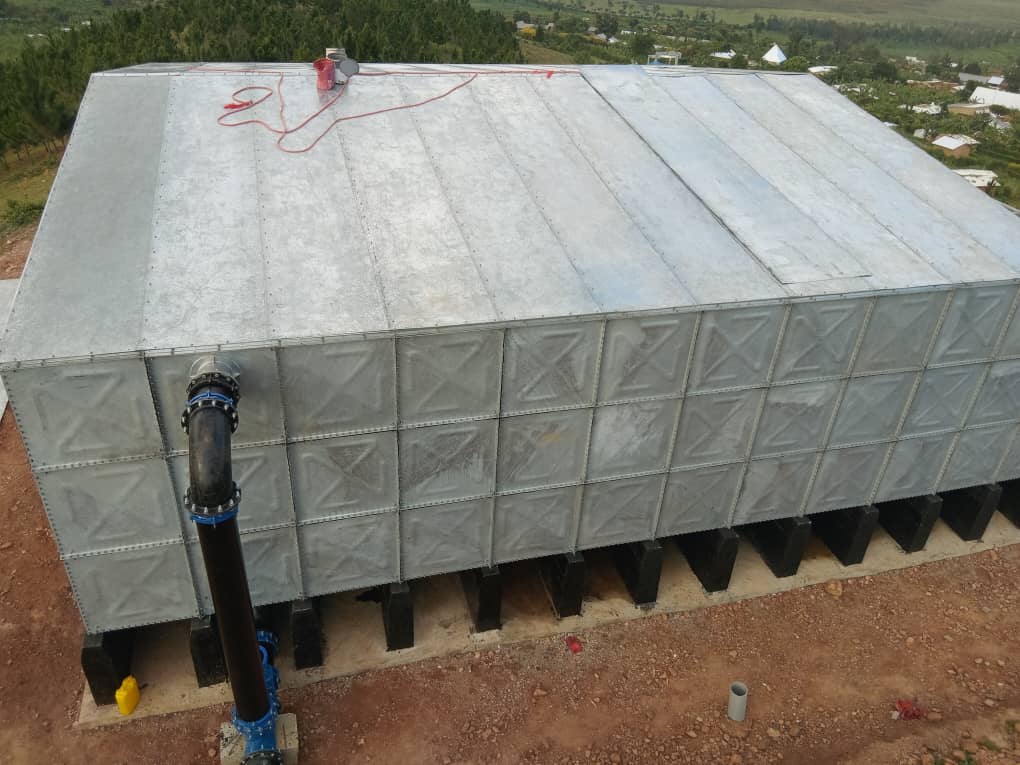
Beyond durability, steel tanks also offer significant logistical advantages. Unlike large concrete reservoirs that require extensive site construction, Zen Tanks are supplied as modular, flat-pack systems that can be transported efficiently and assembled on-site within a matter of days. This approach reduces project timelines, minimizes disruption, and allows organizations to begin benefiting from their water storage investment much sooner.
For projects in Ethiopia, Zenith Steel combines proven East African experience with location-specific engineering considerations, including foundation design, structural anchoring, and environmental adaptations. The result is a water storage solution that supports operational continuity, infrastructure resilience, and long-term value creation.
Ethiopia’s water storage requirements are shaped by distinct seasonal rainfall patterns and growing demand from industry, agriculture, institutions, and commercial developments. While the majority of rainfall is received during the Kiremt season (June to September), the prolonged dry Bega period (December to February) often places significant pressure on available water resources. In many regions, inconsistent Belg rains further reinforce the need for reliable, long-term water storage solutions.
Beyond seasonal water availability, Ethiopia presents additional infrastructure considerations due to its location within the East African Rift System. Projects in various parts of the country may require enhanced structural design considerations to address local environmental and site-specific conditions.

At Zenith Steel, every Zen Tank installation is evaluated based on factors such as location, terrain, foundation requirements, intended application, and long-term operational objectives. This engineering-led approach helps ensure durability, reliability, and performance across a wide range of operating environments, from industrial zones and agricultural regions to educational institutions and commercial developments.
Four sector profiles dominate our Ethiopia tanks installation:
- Industrial parks (Hawassa, Bole Lemi, Kombolcha, Mekele): 100 to 500 cubic metres of process water with NSF/ANSI 61 food-grade epoxy interior for textile, leather and pharmaceutical lines. The Industrial Parks Development Corporation (IPDC) manages 11 SEZs and our spec matches their utility schedule.
- Commercial farms (Awash Valley, Ziway): 250 to 1,000 cubic metres feeding centre-pivot and drip systems on cotton, sugar cane and horticulture; Ziway alone has roughly 205 square kilometres of irrigated land.
- Hospitals and universities (Addis, Mekele, Bahir Dar, Hawassa): 50 to 200 cubic metres of potable storage with a compliant access tower, two-pump booster and NSF/ANSI 61 coating certified per shipment.
- Highland hotels and lodges (Lalibela, Bahir Dar, Gondar, Simien gateway): 30 to 100 cubic metres with an insulated panel jacket and heat-traced outlets above 2,700 metres.
For irrigation-led work, this post cross-references our large-scale steel water tanks for Ethiopia’s irrigation schemes and agro-industry post; this one focuses on the Zen Tanks product spec and industrial-park sizing.
Successful water storage projects depend not only on tank design but also on efficient project execution, rigorous quality control, and reliable commissioning processes. At Zenith Steel Fabricators Ltd, every Zen Tank project is delivered through a structured engineering approach that ensures consistency from manufacturing through installation and handover.
Depending on project size and site conditions, installation can often be completed within days rather than months, helping industrial facilities, agricultural operations, institutions, and commercial developments accelerate operational readiness.
Every delivery leaves Nairobi as a numbered flat-pack of panels, bolts, gaskets, coating drums and an erection booklet. Transport is through the Mombasa-Moyale, or via Moyale-Hawassa for southern sites road networks. Lead time runs 6 to 8 weeks ex-Nairobi including galvanising and shop coating. A 200 cubic metre tank bolts up in 5 to 7 days; we send an erection supervisor above 300 cubic metres or for towers over 4 metres, which has cut commissioning by two days on average.

A typical commissioning file includes mill certificates, galvanising film-thickness log, bolted-joint torque chart, internal coating thickness map, hydrostatic test record at full design head, and a chlorine flush certificate for potable duty. The same discipline carries our multi-storey steel commercial buildings in Addis Ababa work and commercial poultry shed builds for Ethiopian farmers. Our Namibia water storage strategic asset post sets the regional context; Ethiopia sits at the demanding end, solved by the same Zen Tanks family with country-specific anchoring, insulated jackets and NSF/ANSI 61 linings.
When evaluating steel water tanks in Ethiopia, decision-makers should focus on five critical considerations:
- Required storage capacity throughout extended dry seasons
- Site-specific environmental and geological conditions
- Water quality and coating requirements
- Climatic performance considerations
- Applicable regulatory standards
These factors helps ensure long-term reliability, operational efficiency, and maximum return on infrastructure investment during the planning stage.