

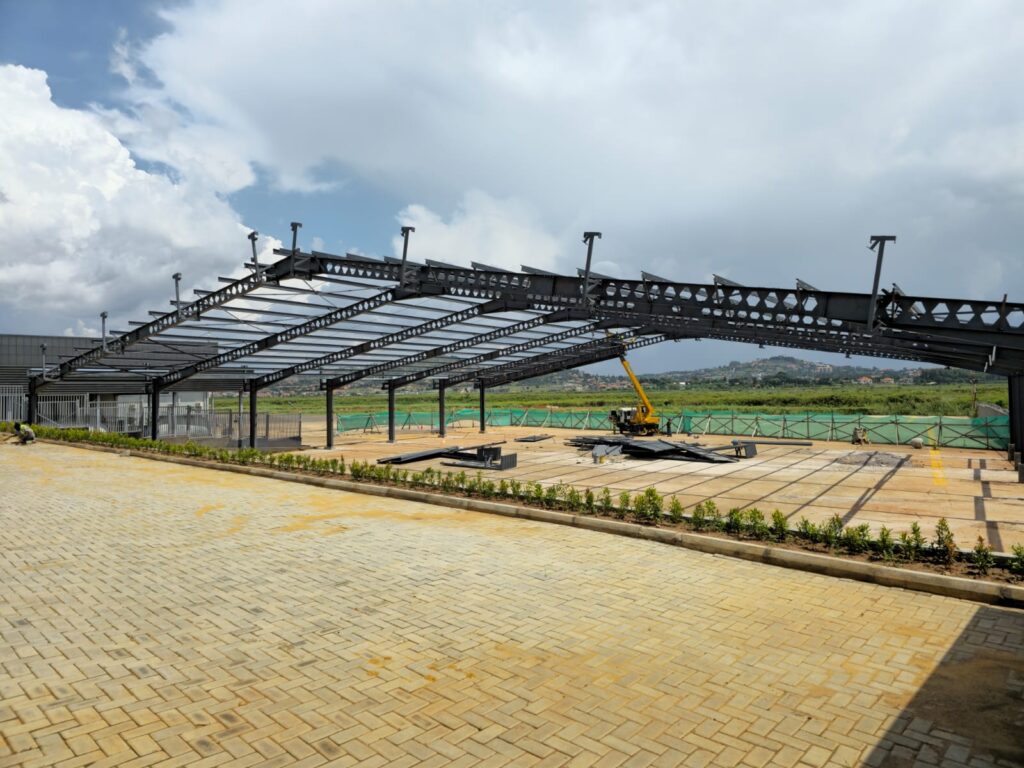
Structural Steel Safety Standards in Uganda
Structural steel safety standards in Uganda blend the country’s Occupational Safety and Health Act (2006) with British Standard BS EN 1993, ISO 9001 quality management and AWS D1.1 welding, plus material traceability through the Uganda National Bureau of Standards (UNBS). On every Kampala-zone project, Zenith Steel applies that full stack from mill cert to final torque. The structural steel safety standards Uganda enforces today are stricter than they were a decade ago, and project sign-off depends on getting them right from day one.
Why Uganda’s Build Cycle Demands Tighter Steel Standards
Uganda’s construction pipeline has not slowed in fifteen years. New industrial parks at Namanve, Kapeeka and Mbale, commercial towers across Kampala’s Central Business District, and warehousing along the Jinja road corridor all rely on steel framing. The more vertical Uganda builds, the more exposed it becomes to the cost of a single weld failure or a single rigging mistake. In our work across the Kampala-Jinja axis, we have seen how a missed mill certificate or a rushed lift plan can stall a hand-over by months.
The structural steel safety standards Uganda contractors face fall into three groups: statutory law (OSH Act 2006 and Building Control Act 2013), technical codes (BS EN, ISO, AWS), and product certification (UNBS). Each of the three has its own paperwork and its own inspection moment, which is why projects benefit from a fabricator who folds them all into one delivery file. From our project notes, this single-file approach has shaved an average of three working days off NBRB and UNBS verification windows in Kampala.
The legal backbone is twofold. The Occupational Safety and Health Act, 2006 sits under the Ministry of Gender, Labour and Social Development and is enforced by the Department of Occupational Safety and Health. The Building Control Act, 2013 is enforced by the National Building Review Board (NBRB) and underpins the National Building Code 2019 and the Building Control Regulations 2020. For steel itself, the operative technical codes are BS EN 1993 (Eurocode 3), ISO 9001, AWS D1.1, and hot-dip galvanising to ISO 1461. These are the same anchors Zenith Steel certifies to on every Uganda contract, in line with our structural steelworks practice for commercial and industrial projects.
Climate adds a further load case. Kampala humidity sits above 70% for much of the year, which speeds corrosion on uncoated steel. By default we ship every Uganda fabrication hot-dip galvanised or epoxy-coated. Projects near Lake Victoria, such as jetties, water towers, and fish-processing sheds in Entebbe, see additional chloride exposure in the splash zone. For those we specify thicker section plate and full-perimeter weld inspection.
How Zenith Steel Applies Safety Standards on Uganda Projects
The structural steel safety standards Uganda projects rely on are only as good as the workshop discipline behind them. On every Uganda contract our team runs six checkpoints before a beam ever leaves the workshop:
- Mill test certificates traceable to the original source
- Tekla model clash-check, so safety is designed in rather than retrofitted on site
- Welder qualification under AWS D1.1 and EN ISO 9606
- Hot-dip galvanising to ISO 1461 or a zinc-rich epoxy coating system
- Pre-shipment QA dimensional report cross-checked against the Tekla cut list
- Site-erection method statement signed by the Uganda-side resident engineer
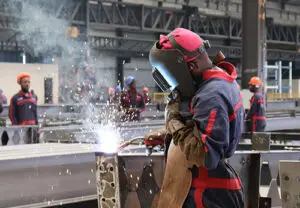
Site PPE and Lift Planning
PPE on a Ugandan site includes full-body fall-arrest harnesses with life-lines anchored to the steel itself, hard hats with chin strap (mandatory for any work above 1.8 metres), and steel-toe boots rated for hot-work environments. Every crane lift over 5 tonnes carries a documented lift plan signed off by both the Zenith rigger and the client’s safety officer. The Department of Occupational Safety and Health can request that file at any unannounced inspection, so it stays on site for the duration of erection. For multi-storey work, we coordinate the lift sequence with the multi-storey buildings programme so column splices and beam landings line up with the crane’s load chart.
Material Certification and the UNBS Pathway
UNBS sits inside the Ministry of Trade, Industry and Cooperatives and certifies steel quality through the East African Standard family, including US EAS 412 for concrete reinforcement and BS EN 10025 equivalents for hot-rolled sections. UNBS has actively enforced against substandard steel imports since 2022, so every load Zenith Steel sends to Uganda travels with a delivery dossier built for the inspector at the gate: mill certs, fabrication QA, weld map, dimensional report, and HDG film-thickness readings. The structural steel safety standards Uganda’s inspectors check at the gate map directly onto each of those documents, so the dossier is laid out in inspector order. We have learned to format it so that any UNBS or NBRB officer can pull the document they want in under sixty seconds.
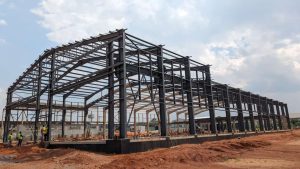
Three field details earn the most attention from Ugandan inspectors. First, hot-dip galvanising film-thickness on every column foot, which we record with a calibrated Elcometer at three points per member. Second, weld procedure specifications matched to welder qualification cards, which travel as scanned copies in the dossier. Third, torque values on bolted connections, which our site engineer logs at 100% witness for primary frame and 25% sample for secondary steel. Each of these three is a fail-stop item under the structural steel safety standards Uganda has tightened since 2022.
For our Uganda cluster work, this discipline also feeds adjacent projects: the poultry-shed and cow-barn construction lines for Ugandan farmers, the pallet racking and warehouse design for the Kampala logistics sector, and the water storage builds for off-grid Ugandan communities all run off the same certification spine.
Cross-Border Lessons from the Kenyan Cluster
Our Kenya safety post covers the parent cluster on welding, lifting and erection protocols. Uganda’s regime overlaps in many places: BS EN 1993, AWS D1.1, ISO 9001, and ISO 1461 are common anchors. The differences worth flagging for the structural steel safety standards Uganda imposes are the NBRB’s permit pathway under the 2013 Act, the UNBS pre-shipment inspection regime for imported steel, and the humidity-driven default to hot-dip galvanising on every member. In our experience, Ugandan contractors who follow this stack early in the design phase, rather than retrofit it during fabrication, save roughly four to six weeks of programme on a typical 300-tonne commercial steel build.
One more cluster lesson worth sharing: handover documentation. Kenyan projects often hand over with a single QA binder. Ugandan projects under the 2013 Act increasingly require a digital duplicate accessible to the NBRB review committee. We now issue a USB plus a cloud folder by default for every Uganda hand-over, so the as-built file matches the structural steel safety standards Uganda’s reviewers expect under the 2019 Code.

The Bottom Line for Ugandan Contractors and Clients
Safety on a steel project is the visible part of a much larger structure. What you see is the harness and the hard hat. What underwrites it is BS EN material certification, a Tekla clash-detected model, certified welders, a documented lift plan, and a UNBS-ready delivery dossier. The structural steel safety standards Uganda projects must meet are not a single tick-box, they are this full chain held together. Zenith Steel handles each piece as one package. If you need to discuss a Kampala or Jinja project, please use our contact page or request a fast quotation through the project quotation form.
Frequently Asked Questions
Which Ugandan body certifies structural steel safety on commercial projects?
The Department of Occupational Safety and Health, within the Ministry of Gender, Labour and Social Development, regulates on-site occupational safety. The National Building Review Board (NBRB) administers the Building Control Act 2013 and the National Building Code 2019. UNBS certifies the steel material itself.
What is the minimum corrosion protection Zenith Steel uses for Uganda projects?
Hot-dip galvanising to ISO 1461 is the default. For Lake Victoria splash-zone projects and Entebbe shoreline work, we add a zinc-rich epoxy topcoat for extended service life under chloride exposure.
Does Zenith Steel manage erection in Uganda or only fabricate?
Both. Our erection crews work out of Kampala under contract for commercial and industrial projects across Uganda, with rigging partners in Jinja and Mbarara for regional jobs.
How does Zenith Steel prepare for UNBS and NBRB inspections?
Every Uganda delivery travels with a pre-formatted dossier: mill certs, fabrication QA report, weld map, dimensional report, and HDG film-thickness records. The site file is mirrored at the Kampala office so any inspector can verify within sixty seconds.
