

Local Steel Fabrication in Uganda: Economic Impact

Local steel fabrication in Uganda is now the working default for serious commercial and industrial builds in Kampala, Jinja and Namanve. Regional fabrication, meaning workshops inside the East African Community feeding the Ugandan market on EAC trade terms, has shortened lead times, narrowed FX exposure and tightened the quality chain that the Uganda National Bureau of Standards expects at port of entry and at hand-over. Zenith Steel ships into Uganda from its Nairobi works, fully fabricated and ready to erect on the Kampala-Jinja corridor.

Why Imported Finished Steel No Longer Wins on a Ugandan Site

Uganda’s construction calendar has thickened steadily. The Kampala Industrial Business Park at Namanve and the Liao Shen park at Kapeeka, the Sino-Uganda Mbale park, the Soroti industrial park, the upcoming Kampala-Jinja Expressway PPP, the Hoima oil refinery programme at Kabaale, and the new Standard Gauge Railway Malaba-Kampala alignment all draw on structural steel for sheds, warehouses, multi-storey administrative blocks and water-tower frames. Until recently almost every kilogram of fabricated steel landed in Kampala as a finished package from China or Turkey. In our work on Ugandan sites, that route stacks a meaningful landed-cost premium once sea freight, Mombasa port handling, Kenya transit and Malaba clearance are layered in, plus 14 to 18 weeks of programme time and a foreign-currency invoice hedged against the Ugandan shilling.

Local steel fabrication Uganda projects depend on, served from EAC works, removes most of those drags. Steel arrives cut, drilled, welded and galvanised, invoiced in EAC currencies, crossing at Malaba or Busia under the EAC Common Market protocol rather than as a third-country import.

Two structural drivers explain why the import model is fading. First, the Northern Corridor (Mombasa, Nairobi, Malaba, Kampala) runs roughly 1,170 km of working road, so fabricated steel can land in Kampala in 7 to 10 days from the Nairobi works against months for a sea route from Asia. Second, under the EAC Common External Tariff, fabricated steel originating inside the bloc clears Malaba on intra-EAC terms rather than the third-country bands that apply to Asian imports, with the delivery dossier pre-formatted to UNBS Pre-Export Verification of Conformity acceptance criteria.

Zenith Steel fabricator preparing a structural beam for a local steel fabrication Uganda project bound for Namanve industrial park

The Economic Math for a Ugandan Project

The case for local steel fabrication in Uganda compounds across cost, schedule and risk. On cost, regional fabrication strips out the international sea freight, the Mombasa port handling on a fabricated container, and the foreign-currency margin on an offshore invoice. From our delivery records on recent Kampala and Jinja projects, the result is a meaningful saving in landed cost on a typical 300 to 500-tonne commercial frame.

On schedule the gain is concrete. Asia-sourced fabricated steel typically books 14 to 18 weeks from PO to delivery, plus 2 to 3 weeks of port and clearance risk at Mombasa. Served from Nairobi, the same package ships in 7 to 10 days by road, with the fabrication window running concurrent with foundation works. For a 500-tonne commercial tower in the Kampala central business district that compresses the structural critical path by two to three months, which carries through to interest cost and the contractor’s preliminaries.
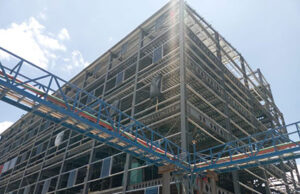
On risk two items matter most: FX exposure and quality recourse. An offshore invoice locks the project to a future US-dollar conversion at an unknown rate, and any non-conformance has to be argued across two jurisdictions and a sea route. A regional fabricator invoices in EAC currencies and answers a non-conformance on a 7 to 10-day truck rather than a 12-week container.

The wider effect is straightforward. Each tonne of structural steel processed inside East Africa keeps the cutting, drilling, welding and galvanising value-add inside the EAC. That supports skilled jobs at the workshops, feeds tax base in Kenya and Uganda, and reduces the bloc’s trade deficit on engineered metal goods. Across Uganda’s industrial parks pipeline coordinated by the Uganda Investment Authority, the cumulative effect on regional construction GDP is material.

What Zenith Steel Brings to the Ugandan Market

Zenith Steel’s Nairobi works is the closest fully integrated structural steel fabricator to the Kampala market, with Tekla and AutoCAD detailing, ISO 9001, BS EN 1090, AWS D1.1 welding, and hot-dip galvanising to ISO 1461 on a single site. Every Uganda contract runs the same delivery spine:

  • Same-day quote against a Tekla-modelled bill of materials
  • Fabrication to BS EN 1993 Eurocode 3 and BS EN 1090 Execution Class 2 or 3
  • Hot-dip galvanising in-house to ISO 1461 as the warranty default, with no third-party HDG outsourcing
  • Mill certificates, fabrication QA, weld map, dimensional report and HDG film-thickness readings in an inspector-ready dossier formatted to UNBS acceptance criteria
  • Site erection crew dispatched from Nairobi for projects above 150 tonnes, working with Kampala-based crane and rigging partners under Zenith supervision
  • Cluster-linked design support for industrial parks, with multi-shed builds priced as a single package

BS EN 1090 Execution Class is the part of the spec that Ugandan consultants increasingly write into tender. We treat it as a default. For a multi-storey commercial frame in the Kampala CBD that is typically Execution Class 3; for a single-storey shed at Namanve, Kapeeka, Mbale or Soroti, Execution Class 2 covers the case. UNBS technical references map onto these European classes through the bureau’s PVoC inspection regime.

For our Uganda cluster this spine feeds adjacent project lines: the pallet racking and warehouse design service for Kampala’s growing logistics sector, the poultry shed and cow barn construction line for Ugandan commercial farmers, and the water storage solution for off-grid Ugandan communities and farms. The completed 590 cubic-metre steel tank project on dwarf walls in Uganda is the practical case study. Cross-border context for the wider regional economic argument sits in our East Africa local steel fabrication economic impact post.

Galvanised structural steel sections staged for a local steel fabrication Uganda commercial project at Namanve

How the Northern Corridor Logistics Stack Works

The honest constraint on local steel fabrication Uganda relies on is the road. The Northern Corridor runs Mombasa to Kampala via Nairobi and Malaba, roughly 1,170 km of working road. The practical leg from the works is Nairobi to Kampala, which we book at 7 to 10 days door-to-site. Convoys carrying long members sit inside the standard trailer envelope, so no abnormal-load permits are needed for typical column and beam lengths. Steel fabricated in Kenya enters Uganda on intra-EAC terms, with the delivery dossier pre-formatted to what Uganda Revenue Authority and UNBS inspectors expect at Malaba. For projects above 150 tonnes we send a Zenith site supervisor under the same lift-plan discipline used on our structural steelworks practice for commercial and industrial projects.

The Bottom Line for Ugandan Developers and Contractors

Local steel fabrication in Uganda is the operating reality on the Namanve industrial belt, the Kapeeka and Mbale parks, the Soroti park, the Kampala-Jinja corridor and the upcoming SGR works. The arithmetic favours regional fabrication on landed cost, schedule, FX, quality recourse and regional economy. To discuss a Ugandan project, use our contact page or the project quotation form.

Frequently Asked Questions

How long is the typical Kampala delivery from the Nairobi works?

From our Uganda delivery records, the practical window is 7 to 10 days door-to-site for standard structural projects on the Northern Corridor. The leg runs Nairobi to Malaba to Kampala, with EAC intra-bloc clearance at the border rather than third-country import procedures.

Does Zenith Steel handle UNBS pre-shipment inspection?

Yes. The delivery dossier travels with mill certificates, fabrication QA, weld map, dimensional report and hot-dip galvanising film-thickness readings, all pre-formatted to UNBS Pre-Export Verification of Conformity acceptance criteria. The dossier is the same one that satisfies Uganda Revenue Authority at Malaba.

What BS EN 1090 Execution Class does Zenith Steel fabricate to for Ugandan projects?

Execution Class 2 is the default for single-storey sheds at Namanve, Kapeeka, Mbale, Soroti and the Jinja industrial zone. Execution Class 3 is the default for multi-storey commercial frames in the Kampala central business district and for the larger Hoima refinery support buildings. Each class is issued with the corresponding welding and inspection regime.

Can Zenith engage Ugandan-side erection contractors?

Yes. For projects above 150 tonnes we send a Zenith site supervisor from Nairobi and work with Kampala-based crane and rigging partners under our lift-plan and method-statement discipline. For smaller jobs we hand the erection package to the developer’s main contractor with a rigging guide and a remote handover.

Leave a Reply

Your email address will not be published. Required fields are marked *